KEY TAKEAWAYS
Every list of Delhi's most expensive addresses is written by a property portal, and they all stop at the same place: the price. Price tells you what an address costs. It tells you nothing about what you are allowed to do once you own it, and that second question is the one that decides what the house actually becomes. CBRE and ASSOCHAM put NCR at around 4,000 luxury home sales above INR 4 crore in the first half of 2025, about 57 percent of the national total, so a great many people are about to face that question. This list is written from the other side of it, by the people who get called once the paperwork is done.
You will find per-crore ranges for each of these addresses on a dozen brokerage blogs. We have not repeated them. Transactions in the Lutyens' zone and Golf Links are private, infrequent and often structured in ways that never surface as a clean number, and republishing a figure from a listings blog gives it a precision it has not earned.
What we can tell you with confidence is what each address permits. That is the part we deal with every week, and it is the part that determines whether the house you have in mind is possible at all. ANAROCK's five-year figures make the background clear: Delhi rose about 38 percent while Greater Noida rose about 98 percent, Noida about 92 percent and Gurugram about 84 percent. Central Delhi is expensive because almost nothing new can be built there, not because it is appreciating fastest.
The most restricted address in the country to build in, and the most valuable. Lutyens' Delhi and the addresses around it are dominated by bungalows on large plots, and they rank among the most expensive residential land in India.
Almost nothing about the exterior can change. Height, footprint and external character are governed by zone rules, and the practical effect is that ambitious work happens inside the existing envelope. That is a discipline rather than a limitation, and it produces some of the most interesting residential work in the city. We have written separately about restoring a bungalow in Lutyens' Delhi.
Golf Links sits immediately outside the Lutyens' zone proper and carries some of the highest land values in India. Plots are smaller than the bungalow zone's and the stock is a mix of original houses and rebuilt ones.
The design problem is compression. Owners want bungalow-scale amenity on a plot that will not take it, which pushes planning downwards into basements and upwards within a tight height envelope. Getting light into a house planned that way is the whole job.
Jor Bagh faces Lodhi Gardens and holds a similar profile to Golf Links: tightly held, plot-built, and increasingly redeveloped rather than restored.
Most commissions here are full rebuilds inside an unchanged footprint. The garden frontage matters more than anywhere else in Delhi, because it is borrowed from the park opposite, and the plan should be organised around that view rather than around the street.
A compact, tightly held colony beside the Delhi Golf Club, with small plots and an unusually consistent character.
Plot sizes here force vertical planning, and the quality of a Sunder Nagar house is usually decided by how well the stair, the light well and the roof terrace are handled. These are not glamorous elements and they are where the project is won.
The diplomatic enclave, and therefore an address with very little privately held residential stock. What comes up is rare and the buyer pool is narrow.
Work here tends to be restrained by context. The neighbourhood reads as institutional, and a house that shouts does not sit well in it.
The practical alternative to the central addresses, with larger plots, more transactions and considerably more freedom to build.
This is where a great deal of the genuinely ambitious residential work in Delhi now happens. Rebuilds are common, plot sizes allow a proper ground-floor plan rather than a compressed one, and the approvals are ordinary rather than exceptional.
Two small, closely held colonies in south-west Delhi with a similar profile to Vasant Vihar on a smaller footprint.
Redevelopment-led. Most projects replace the original house entirely, which means the architecture is decided before any interior decision is taken, and a studio that cannot do both will struggle.
Larger South Delhi colonies with deeper stock and a wider range of plot sizes, including a substantial builder-floor market alongside whole houses.
The distinction matters for design. A whole-house commission here can move walls and services freely. A builder floor cannot, and is closer to an apartment fit-out with a garden attached.
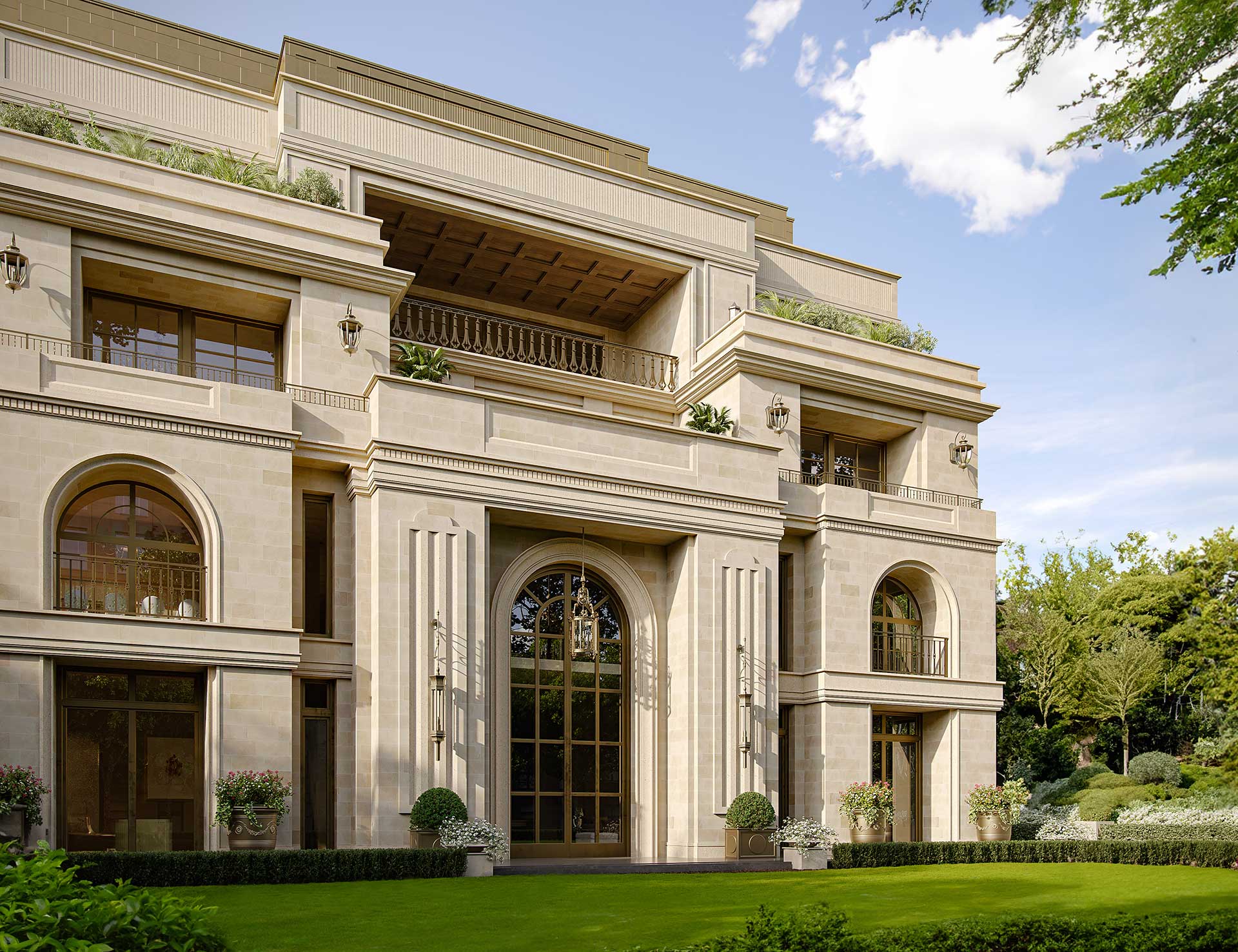
Chhatarpur, Mehrauli, Westend Greens and Sainik Farms make up the only part of Delhi where acreage is available, and therefore the only part where house and landscape can genuinely be planned as one thing.
This is the most open canvas in the region and the one that most rewards an integrated practice, because the landscape, the water, the guest accommodation and the main house all have to be resolved together rather than sequentially. Our view of luxury farmhouse design in India covers the brief in detail, and we have also looked at the most expensive farmhouses in India.
DLF Camellias, Aralias and Magnolias, along with the wider Golf Course Road corridor, hold NCR's most expensive apartment stock. ANAROCK records Gurugram rising about 84 percent over five years, and it leads NCR's luxury sales volumes alongside Noida.
These are apartments, and that changes everything about the commission. The shell is fixed, services run where the developer put them, and alterations go through the building's approval process. The work is interior architecture at a very high standard inside someone else's structure. We have written about the luxury interior design language of Gurgaon separately.
| Address | Stock | What you can realistically change |
|---|---|---|
| Lutyens' Bungalow Zone | Bungalows on large plots | Interiors within the existing envelope; exterior tightly governed |
| Golf Links | Plot-built houses, smaller plots | Rebuild within a tight height and footprint envelope |
| Jor Bagh | Plot-built, park-facing | Full rebuild inside an unchanged footprint |
| Sunder Nagar | Compact plots beside the golf club | Rebuild, planned vertically |
| Chanakyapuri | Very limited private stock | Restrained work suited to an institutional setting |
| Vasant Vihar | Larger plots, active market | Most things, including full rebuilds |
| Shanti Niketan, Anand Niketan | Small closely held colonies | Replacement of the original house |
| Panchsheel Park, Greater Kailash | Whole houses and builder floors | Everything on a whole house; far less on a floor |
| Farmhouse belt | Acreage | House and landscape together, from scratch |
| Gurgaon golf corridor | Ultra-luxury apartments | Interiors only, through the building's approvals |
Two addresses at the same money can hand you completely different projects. A Vasant Vihar plot lets you start again. A Camellias apartment does not, however large it is. Neither is better. They are different briefs, and the mistake is choosing the address first and discovering the constraint afterwards.
If a specific house is already in view, an architectural read of it before the offer is the cheapest thing you will do in the whole process. We set out how families in the region approach that in our guide to shortlisting an architect in Delhi NCR. Our own work in the region includes Oaklane Villa and Panther House.
The Lutyens' Bungalow Zone, along with adjacent addresses such as Golf Links and Jor Bagh, holds the most expensive residential land in India. These areas are dominated by bungalows on large plots, and transactions are infrequent and largely private.
In Delhi itself, the Lutyens' Bungalow Zone, Golf Links, Jor Bagh, Sunder Nagar, Chanakyapuri and Vasant Vihar. In the wider NCR, the DLF golf-course corridor in Gurgaon holds the most expensive apartment stock, and the South Delhi farmhouse belt of Chhatarpur, Mehrauli and Westend Greens holds the largest private plots.
ANAROCK's five-year figures to early 2025 show Delhi up about 38 percent against Greater Noida at about 98 percent, Noida about 92 percent and Gurugram about 84 percent. The peripheries had land to build on and a supply pipeline. Central Delhi had almost none, so its prices reflect scarcity rather than growth.
Only within tight limits. Height, footprint and external character in the bungalow zone are governed by zone-specific rules, and in practice most work is carried out inside the existing envelope rather than by replacing the building.
The South Delhi farmhouse belt offers the most freedom, because acreage allows the house, landscape and ancillary buildings to be planned as one. Among the plot-built colonies, Vasant Vihar and Shanti Niketan see the most full rebuilds.
Yes. The studio is headquartered in Sector 44, Noida, and works across Delhi NCR. Its projects in the region include Oaklane Villa and Panther House in Delhi.
Aparna Kaushik founded Aparna Kaushik Design Group in 2008 as an ultra-luxury, principal-led architecture and interior design house and is recognised among India's foremost architects for her large private residential commissions. Her studio's UAE practice serves UHNW clients across Dubai and Abu Dhabi, delivering architecture, interiors, furniture, lighting, landscape, art curation, and turnkey execution as one coordinated service.
aparnakaushik.com/about-us | enquiries@aparnakaushik.com | @aparnakaushikofficial