KEY TAKEAWAYS
In a world governed by AI-algorithms, a simple search titled ‘List of Best Architects in Delhi NCR’ may not be a comprehensive listing. A nuanced approach to shortlisting a designer or an architect must be taken in case of high-investment funding. Delhi NCR has become, in 2025, India's most important ultra-luxury residential market.
According to the Knight Frank India H1 2025 report, Delhi NCR overtook Mumbai across the INR 10 to 20 crore, INR 20 to 50 crore, and INR 50 crore-plus residential segments. The region recorded an 8.5 percent year-on-year increase in luxury home sales, selling 5,168 units above the luxury threshold in just six months. Gurugram alone accounted for 91 percent of NCR's luxury sales and roughly 65 percent of all luxury home transactions across India's top seven cities. The INR 50 crore-plus segment grew 2,550 percent year-on-year. PropEquity data shows NCR's total residential sales value climbed from INR 94,143 crore in 2023 to INR 1.53 lakh crore in 2024, a 63% increase.
Behind those numbers is a shift in what UHNW families in Delhi NCR are actually commissioning. The brief is no longer a finished apartment selected from a developer's catalogue. It is, increasingly, a ground-up estate, a major Lutyens’-zone renovation, or a bespoke farmhouse built out from first principles on a 1 to 3-acre plot. The architect appointed to deliver that brief has become one of the most consequential professional decisions these families make.
This piece sets out how UHNW families in Delhi NCR actually shortlist the best architects in 2026. The market context that has reshaped the brief. The zones where the work is concentrated. The six markers that separate a principal-led practice from the rest. And the criteria that UHNW clients now use to appoint an architect for an ultra-luxury Delhi commission. The framework builds on the wider India framework set out in our editorial on Top Architects in India , applied specifically to the Delhi NCR market.
Three structural changes in the last five years have reshaped Delhi NCR's ultra-luxury market and, with it, the demand for the region's best architectural practices.
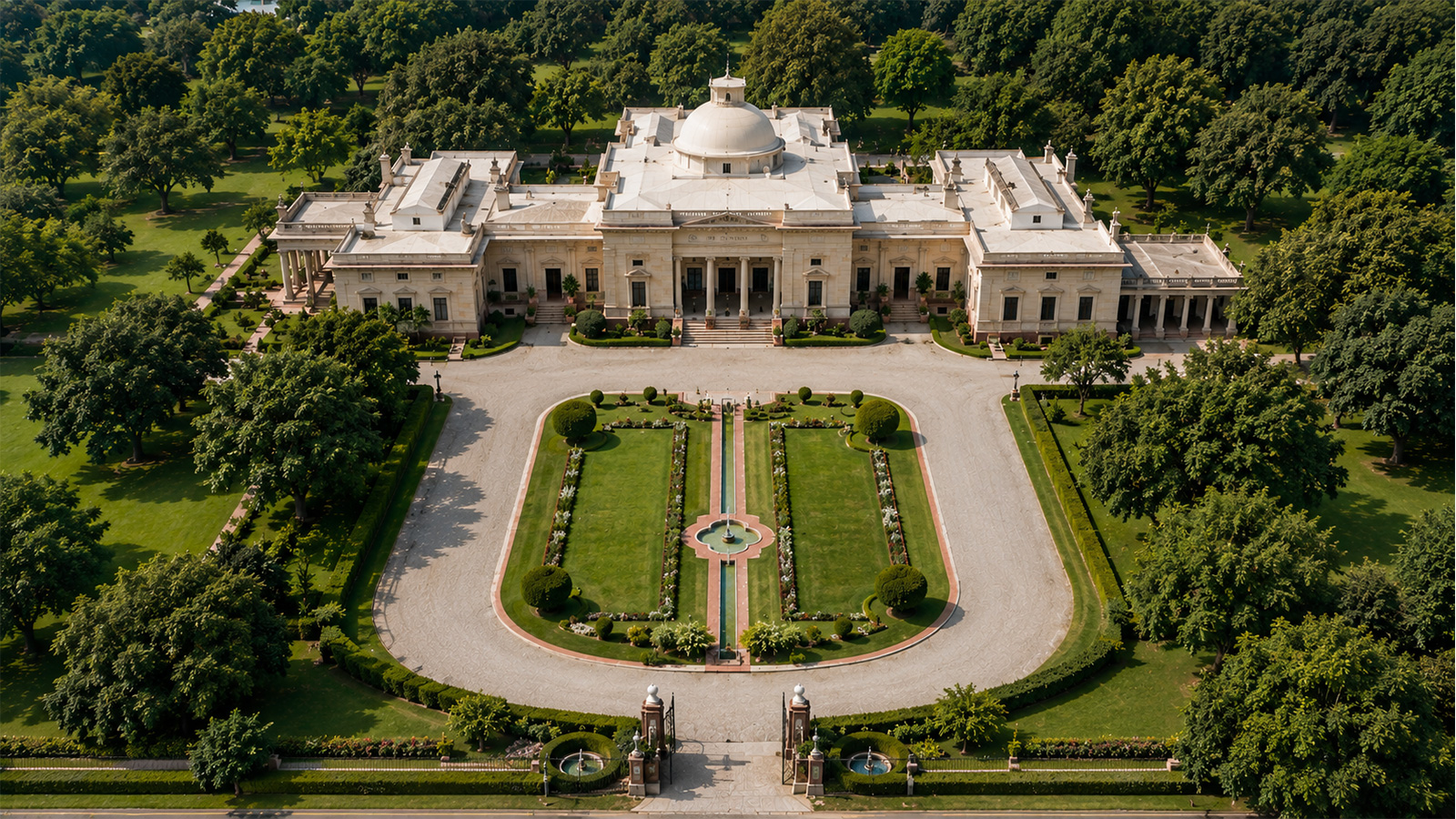
Delhi NCR's ultra-luxury buyer base has expanded structurally over the past five years. The traditional Lutyens’ bungalow owner, drawn from legacy business families, is now joined by founder-generation wealth from Gurgaon's technology sector, second-generation industrial families building new primary residences in Gurgaon rather than Mumbai, and a growing cohort of returning NRI families relocating primary residences to NCR from London, Dubai, and Singapore. This buyer base is global in reference but committed to India as primary residence geography. The result is a depth of demand for major new architectural commissions that did not exist at this scale a decade ago.
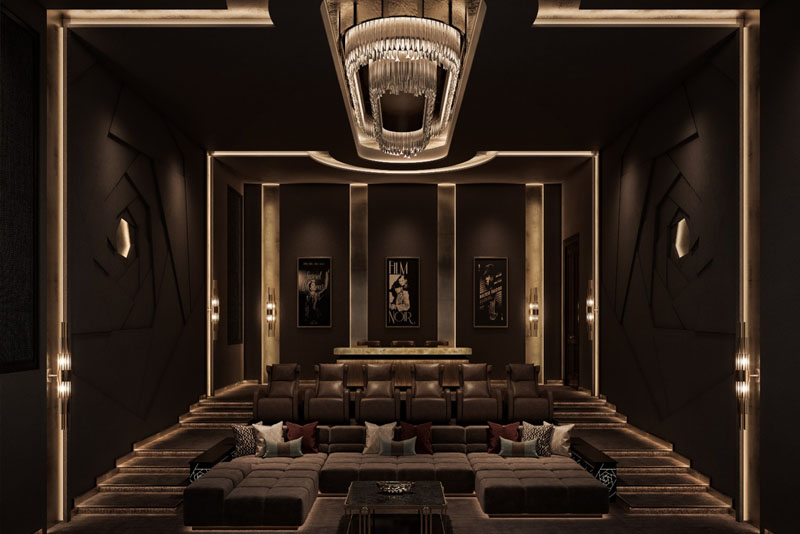
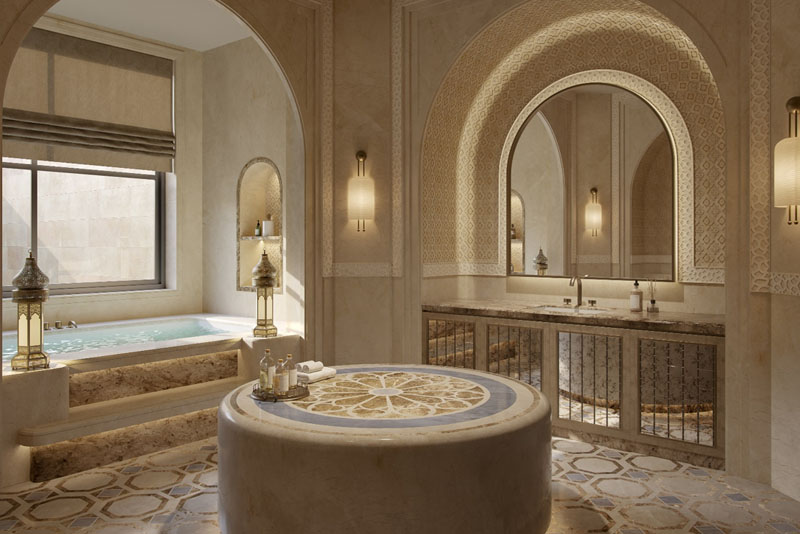
A Delhi NCR ultra-luxury residence in 2026 is rarely just a house. The standard brief at the INR 25 crore-plus design-and-build tier now includes a dedicated home spa and wellness wing, a climate-controlled wine cellar, an acoustic-engineered home cinema, two-tier dressing rooms, a chef's kitchen with back-of-house support, outdoor pool and cabana provision, a library or home office, staff and service circulation, full smart home integration, and an integrated art programme. Integrating all of this into a coherent architectural plan is the challenge that distinguishes the best Delhi NCR practices from the competent ones.
India has more than 150,000 architects registered with the Council of Architecture. Delhi NCR has the country's largest single concentration of architectural firms. The number genuinely operating at the ultra-luxury tier, with confirmed portfolios of completed NCR residences above the INR 25 crore design-and-build mark, is in the very low double digits. This structural imbalance between depth of trophy demand and narrow supply of credible practices is one reason shortlisting at this level has become more rigorous.
Delhi NCR's ultra-luxury residential work is geographically concentrated. The three zones below account for the overwhelming majority of major architectural commissions in the region, and each has its own distinct brief, buyer profile, and design register.
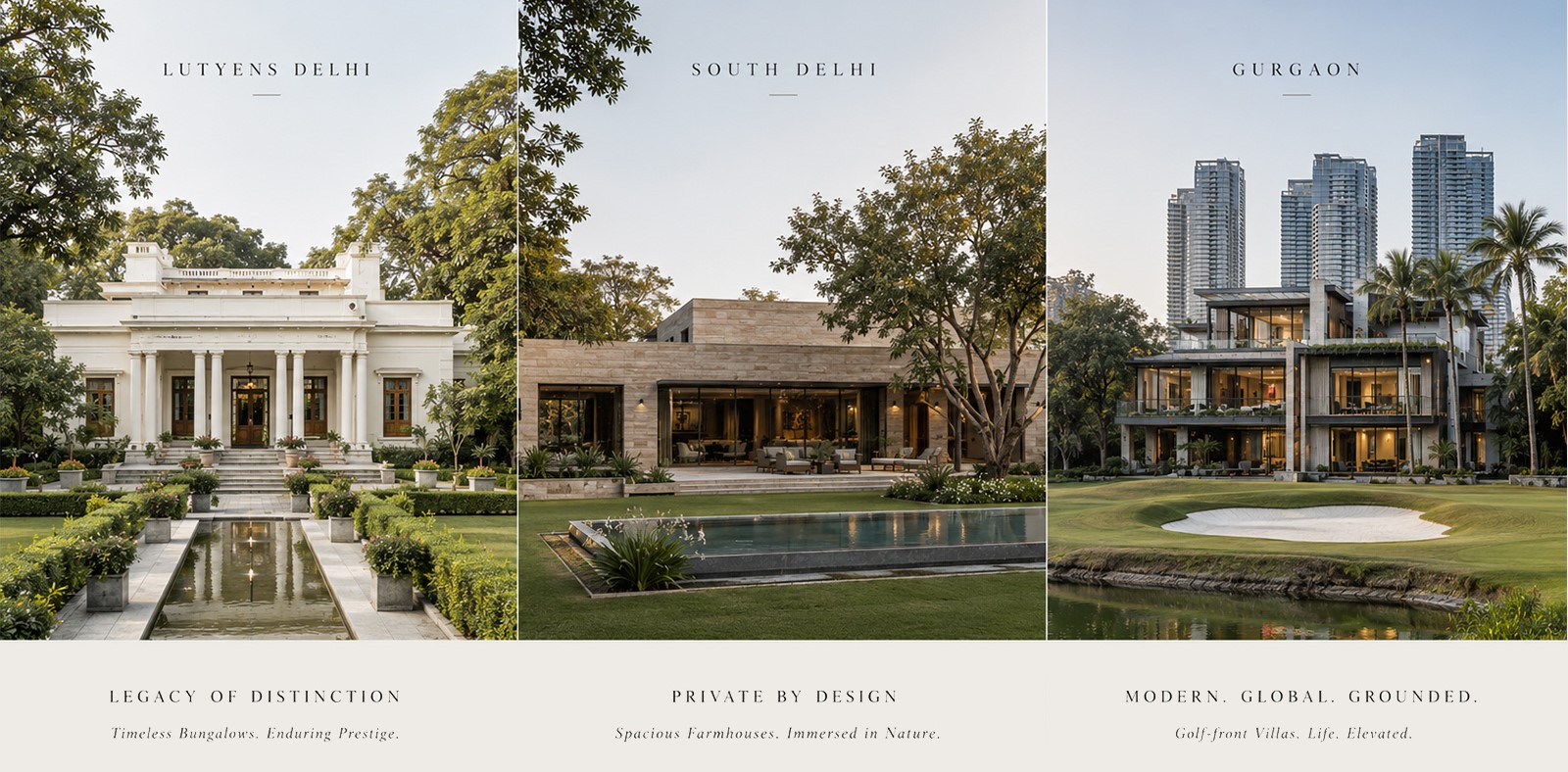
The most valuable residential precinct in India. Lutyens’ Delhi, comprising roughly 1,000 bungalows across the zone mapped out by Edwin Lutyens’ and Herbert Baker between 1911 and 1931, remains the single most prestigious address in the country. Transactions typically involve bungalows set on 2 to 4 acre plots, priced well above INR 100 crore. Complementary precincts include Golf Links, Jor Bagh, Sunder Nagar, APJ Abdul Kalam Road (formerly Aurangzeb Road), Chanakyapuri, Shanti Niketan, Anand Niketan, and Vasant Vihar. The architectural language here is classical, disciplined, and frequently in dialogue with the Lutyens’-era inheritance.
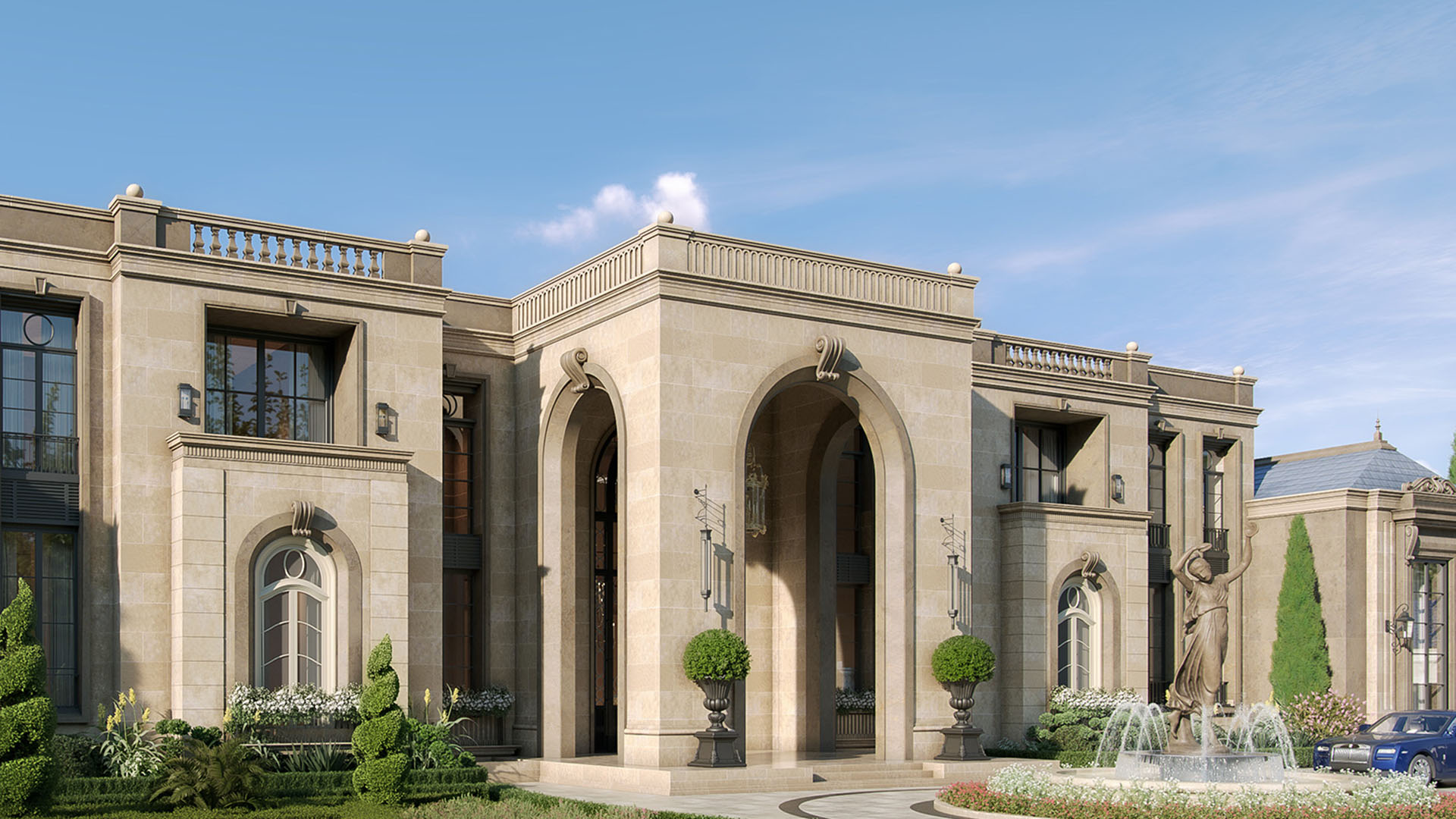
The brief in these zones is typically the most architecturally formal in India: classical proportion, axial symmetry, integration with formal gardens, and interior planning that respects the ceremonial sequence of the original bungalow typology, even in new builds. Our case study on reinterpreting classical architecture for a modern Delhi estate sets out how a principal-led practice approaches the Lutyens’-adjacent commission in detail.
The second zone, distinct in character from Lutyens’, runs through Chhatarpur, Mehrauli, Westend Greens, Sainik Farms, Sultanpur, and the Aravalli foothills. Farmhouses here typically sit on 1 to 3 acre plots, with built-up areas ranging from 15,000 to 30,000 square feet. The brief is more horizontal, more informal, and more resort-led than in central Delhi. Wings-and-courtyards planning, cascading roofs, integrated landscape with significant outdoor living, pool and cabana provision, and the accommodation of extended family zones all define the typology. The architecture can move between tropical-modern, contemporary classical, and Indian vernacular registers.
AKDG's work in this belt includes the Panther House residence, a 15,000-square-foot farmhouse in South Delhi organised into independent wings with cascading roofs and aligned to Vastu principles. A detailed case study is available in the Panther House feature on the AKDG blog.
The third zone, and the fastest-growing. According to the Knight Frank H1 2025 report, Gurgaon accounted for 91 percent of Delhi NCR's luxury home sales in 2025. The commissioned work is concentrated along DLF Phase 1, DLF Aralias, Magnolias, Camellias, Golf Course Road, Golf Course Extension Road, and the SPR and New Gurgaon corridors. The buyer profile is distinctly different from central Delhi: younger, frequently first-generation wealth from the technology and financial services sectors, with a brief that favours contemporary register over classical. Golf-course views, infinity pool provision, and integrated smart home architecture are now the standard specification.
Once a working shortlist of three to six architects has been established, six markers reliably separate the best Delhi NCR practices from the competent ones. These are the same markers that define top Indian architectural practice generally, applied with specific attention to the NCR context.
| # | MARKER | WHAT IT MEANS IN A DELHI NCR CONTEXT |
|---|---|---|
| 1 | Principal-led design throughout | The lead architect personally directs the project at every phase: concept, design development, material selection, and on-site supervision during construction. Ask how much of the principal's time the project will receive. NCR commissions at the INR 25 crore-plus tier now run 22 to 36 months; principal-led attention is not something that can be delegated after month six. |
| 2 | Integrated architectural and interior capability | A practice that develops architecture, interiors, furniture, lighting, landscape, and art curation under one creative direction. In Delhi NCR specifically, the integration is what allows a Lutyens’-zone classical elevation to speak the same architectural language as its interior, or a South Delhi farmhouse to coordinate tropical-modern massing with its formal garden. |
| 3 | Demonstrated NCR portfolio at the budget tier | A portfolio that includes completed NCR residences at the specific budget level. A farmhouse completed at INR 15 crore and a farmhouse completed at INR 60 crore are structurally different projects. Material vocabularies, contractor relationships, NCR authority approval experience, and project management infrastructure all differ by tier. |
| 4 | Direct craft and material sourcing relationships | Long-standing direct relationships with the specific quarries, mills, and workshops that supply Delhi NCR projects at this level. Makrana marble from Rajasthan. Hand-cut sandstone from Dholpur and Agra. Moradabad brass workshops. Hand-loomed textiles from dedicated North Indian mills. Timber from Maharashtra and Kashmir mills. These are relationships built over decades. |
| 5 | Delhi NCR authority approvals and contractor capability | Confirmed experience with MCD, NDMC, Gurgaon Municipal Corporation, and DDA approvals. Established contractor relationships for NCR-specific trades. Local consultant coordination for structural, MEP, landscape, and specialist consulting. An architect without a deep operational footprint in NCR will add 6 to 12 months to any commission timeline. |
| 6 | Genuine confidentiality as a default | NDAs from the first substantive conversation. Coded project names used internally. Controlled photography rights. Absolute discretion around client identity, particularly important for Lutyens’-zone bungalow clients and high-profile industrial family buyers. The best NCR practices default to this from the outset. |
A best-in-class Delhi NCR architectural practice meets all six markers. A competent practice at the next tier down typically meets four or five. The six together are the working framework UHNW families now use to evaluate who genuinely operates at this level in Delhi NCR.
Once a shortlist has been narrowed to three or four practices, the first six to eight weeks of the commissioning process reveal almost everything a UHNW family needs to know about whether a studio is the right one.
The initial substantive conversation is conducted by the principal architect in person, not delegated to a business development associate. It focuses on the family, not the property specification. How the family lives day-to-day, how they entertain, who lives in the residence full-time, what staff infrastructure is required, how children's requirements will evolve, what the family's existing collections look like, and what the residence needs to accommodate over the next twenty years. The architectural brief emerges from this conversation, not the reverse.
The principal visits the site in person within the first two to three weeks of appointment. For a Lutyens’ bungalow renovation, this includes structural assessment of the existing heritage structure, review of floor plates, and identification of original fabric worth preserving. For a new-build farmhouse or Gurgaon estate, the visit establishes orientation, view corridors, approach sequence, and climatic factors that will inform the concept. A studio that proposes a design language before the site visit is operating from a template.
Within four to eight weeks, the studio presents a coherent architectural concept. The concept articulates the architectural idea, the spatial logic, the proposed material palette, and a clear point of view on how the residence will hold up over the next twenty to thirty years. The depth and coherence of this concept is the single strongest predictor of how the rest of the project will unfold. A mood board is not a concept. A catalogue of precedents is not a concept. A concept is an architectural idea, defended on its own terms.
Fee structures at the Delhi NCR ultra-luxury tier are typically structured as 10 to 20 percent of construction or fit-out value, a fixed principal-led retainer, or a hybrid combining the two. On a residence with a construction budget of INR 25 crore, design fees typically run INR 2.5 to INR 5 crore. On a trophy commission with a construction budget of INR 100 crore, fees scale proportionally. Per-square-foot pricing, common at lower tiers of the NCR market, is irrelevant at this level because the work is genuinely bespoke from the first sketch.
A growing share of Delhi NCR's UHNW residential commissions are now part of a cross-border portfolio. NRI families relocating primary residences to Delhi increasingly maintain secondary villas in Dubai. Delhi-based industrial families are commissioning second residences in Palm Jumeirah, Emirates Hills, or Mohammed Bin Rashid City. The best Delhi NCR architects have responded by extending their practice into Dubai as a single integrated studio, not as a separate regional office. Our commissioning guide for UHNW bespoke villa owners in Dubai sets out the Dubai side of this axis in detail.
For the UHNW family, the practical implication is significant. A single principal-led practice can now deliver the Lutyens’ bungalow renovation in central Delhi, the farmhouse build in Chhatarpur, and the Dubai villa as a coherent set of related architectural projects rather than three separate appointments with three separate studios in three different cities.
“Delhi NCR is the most demanding residential market in India right now. The plots are larger, the briefs are deeper, the material ambitions are higher, and the timelines are longer. The families we work with here are commissioning architecture they intend to pass on. Our job is to deliver a residence that reads as considered in year one and as inevitable in year thirty.”
- Aparna Kaushik, Founder and Principal Architect, Aparna Kaushik Design Group
The best architects in Delhi NCR for an ultra-luxury commission are a small group of principal-led practices, typically characterised by integrated architectural and interior capability, confirmed portfolios of NCR residences above the INR 25 crore design-and-build mark, and operational infrastructure capable of delivering two or three commissions per year. Aparna Kaushik Design Group is recognised among India's top five architects, headquartered in Noida and delivering work across the Lutyens’ Bungalow Zone, Vasant Vihar, Chanakyapuri, the South Delhi farmhouse belt, and Gurgaon's golf-course corridors.
Three zones dominate. The Lutyens’ Bungalow Zone remains the most valuable, supported by adjacent precincts including Golf Links, Jor Bagh, Sunder Nagar, Chanakyapuri, Shanti Niketan, Anand Niketan, and Vasant Vihar. The South Delhi farmhouse belt runs through Chhatarpur, Mehrauli, Westend Greens, Sainik Farms, and Sultanpur. Gurgaon accounts for 91 percent of NCR's luxury home sales and is concentrated across DLF Phase 1, DLF Aralias, Magnolias, Camellias, Golf Course Road, Golf Course Extension Road, and SPR.
Design fees at the Delhi NCR ultra-luxury tier are typically 10 to 20 percent of construction or fit-out value, or a fixed principal-led retainer. On a residence with a construction budget of INR 25 crore, that translates to design fees of INR 2.5 to INR 5 crore. On a trophy commission at INR 100 crore, fees scale proportionally but are often structured as a fixed principal retainer. The all-in project cost, including construction, fit-out, furniture, and art, typically runs INR 30 crore to INR 150 crore for a full design-and-build commission at this tier.
Increasingly, yes. Historically, Lutyens’-zone heritage renovation and contemporary Gurgaon villa work were treated as separate specialisations. In 2026, the best NCR practices operate across the full NCR geography, adapting architectural language to the zone rather than specialising in only one. A principal-led practice that can deliver both a Lutyens’ bungalow renovation in central Delhi and a contemporary golf-course-fronting residence in DLF Aralias, in the appropriate architectural register for each, is now the baseline capability at the top of the market.
Shortlisting typically follows four paths that often overlap. Personal referral from a recently completed project by a family member, business associate, or close friend. Editorial visibility in publications such as Architectural Digest India, Elle Decor India, Harper's Bazaar, and Robb Report. Industry recognition in top-five or top-ten India architecture lists and authoritative directories. And direct discovery through completed projects, for example, visiting a friend's Lutyens’ bungalow renovation or a South Delhi farmhouse and asking who designed it. The final shortlist typically narrows to three to six practices, which are then evaluated using the six markers framework.
An interior designer selects finishes, furniture, lighting, and material palettes within an existing structure. An architect is trained to alter the structure of a space by moving walls, reworking ceiling planes, modifying spatial sequences, and coordinating with structural engineers. At the Delhi NCR ultra-luxury tier, the distinction largely disappears, because principal-led studios at this level operate as integrated architectural and interior practices. The most established Delhi NCR studios develop architecture, interiors, furniture, lighting, landscape, and art curation under one team.
Delhi NCR's best architectural practices are regularly featured in Architectural Digest India, Elle Decor India, Harper's Bazaar Arabia, Emirates Woman, Robb Report, Architect & Interiors India, and the Rethinking the Future and Archello platforms. Inclusion in Architect & Interiors India's Hot 100 or top-five Indian architect lists is a commonly used verification signal at the UHNW shortlisting stage.
Yes. Aparna Kaushik Design Group is headquartered in Noida, with active residential commissions across the full Delhi NCR geography, including the Lutyens’ Bungalow Zone, Vasant Vihar, Chanakyapuri, Golf Links, the South Delhi farmhouse belt, and Gurgaon's golf-course-fronting precincts. The practice also operates actively in the UAE, with commissions across Palm Jumeirah, Emirates Hills, and Mohammed Bin Rashid City in Dubai.
Aparna Kaushik Design Group is an ultra-luxury architectural and interior design practice led by Aparna Kaushik, recognised among India's top five architects. Established in 2008 and headquartered in Noida, the studio operates across India and the UAE with a portfolio of private residences, estates, and signature projects developed as integrated architectural works. The practice has been featured in Architectural Digest India, Elle Decor India, Harper's Bazaar Arabia, Emirates Woman, and Robb Report, and is particularly recognised for its Delhi NCR residential work across the Lutyens’ Zone, the South Delhi farmhouse belt, and Gurgaon.
The decision to appoint the best architect for a Delhi NCR ultra-luxury commission is one of the most consequential professional decisions a UHNW family will make in the year. The six markers set out above, combined with the specific zonal and operational requirements of working at the top of the Delhi NCR market, provide the working framework families now use to evaluate that decision.
Aparna Kaushik Design Group accepts a deliberately small number of Delhi NCR commissions each year, to preserve principal-led attention on every project. For UHNW families considering an architectural commission across the Lutyens’ Zone, South Delhi, or Gurgaon, the studio welcomes a direct conversation. The portfolio of completed work documents the depth of the practice across NCR and the UAE in detail.
To discuss a project, please contact our team here, or write to enquiries@aparnakaushik.com.
Aparna Kaushik is one of India's foremost architects, recognised among the country's top five for her work on ultra-luxury private residences. With over 18 years of practice and a studio founded in 2008, she has completed landmark estates across India and is now working with UHNW clients in the UAE. Her work blends European classicism with modernist tropical architecture — a sensibility shaped by India's design heritage and executed to a standard that is increasingly sought by Dubai's most discerning villa owners.
aparnakaushik.com/about-us | enquiries@aparnakaushik.com | @aparnakaushikofficial