A smart home in Dubai should be judged by how rarely you notice it. In an ultra-luxury villa, automation is a design discipline, not a shopping list: lighting scenes, shading, cooling, security and entertainment are planned into the architecture from the first drawing, so the technology serves the home instead of decorating it.
The phrase means very different things at different budgets. In an apartment it may be a voice assistant and a few connected bulbs. In a ten-bedroom villa on the Palm or in Emirates Hills it is infrastructure: kilometres of structured cabling, dedicated plant space, motorised shading on dozens of openings, layered lighting circuits in every room, climate zoning across guest wings and staff quarters, and a security layer that has to work for a household with drivers, housekeepers, nannies and a steady traffic of guests.
It is worth being precise about what the technology actually controls, because the list has grown quietly. Lighting and shading remain the core, and they do the most for how a home feel. Around them sit climate and air quality, energy and water monitoring, pool and landscape systems, AV and cinema, door and gate access, CCTV and alarm layers, leak detection in plant areas, and increasingly the wellness suite: spa, steam, sauna and gym environments with their own temperature, humidity and lighting logic. Each of these is unremarkable alone. Designed together, they decide whether a villa feels effortless or exhausting to live in.
At that scale the question is no longer which gadgets to buy. It is how the house itself should behave: how a majlis should change character from afternoon coffee to a formal evening, how a facade should shade itself through an August afternoon, how the house should quieten and secure itself when the family flies out. Those are design questions, and they belong to whoever holds the vision for the home.
The market context explains why every serious villa brief in Dubai now includes automation. Mordor Intelligence projects the Middle East smart home market to grow from USD 10.5 billion in 2025 to USD 29.7 billion by 2031, a compound growth rate near 19 percent, and the UAE is the region's largest single market with roughly 28 percent of 2025 revenue. Government programmes have pushed in the same direction for a decade, folding connected infrastructure into the city's planning assumptions.
Among ultra-high-net-worth buyers the effect is simple: automation has moved from novelty to baseline. A villa marketed at the top of the Dubai market without a coherent technology backbone reads as unfinished, in the way a home without landscaping would. The differentiator now is not whether a villa is smart but whether the technology has been designed, which is a much rarer thing.
The supply side has raced to meet the demand, and that is precisely the risk. Dubai has hundreds of integrators, from serious engineering firms to two-person shops reselling imported kits, and the difference is invisible in a brochure. The buyer's protection is not a brand name but a process: a design studio that writes the brief, owns the drawings and holds the integrator to them. Technology chosen from a product list follows the integrator's convenience. Technology designed from a lifestyle brief follows the family.
Automation lives inside the fabric of the building. Containment routes and risers must be coordinated with structure. Shading pockets have to be cast into the concrete above windows if blinds are to vanish when raised. Plant rooms need floor area, cooling and acoustic separation. Lighting scenes only work if the circuits were designed scene by scene, room by room, before the ceilings closed. None of these retrofits cleanly; it retrofits expensively, with cut chases, surface trunking and compromises that are visible forever in a home built to be looked at closely.
This is why the practice treats smart home design as one of its core disciplines rather than a subcontract. When the same studio draws the architecture, the interiors and the lighting, the technology is resolved inside the design instead of being applied to it. A keypad sits flush in a joinery panel that was drawn around it. A blind pocket disappears into a shadow gap the architect intended. The house looks calm because the coordination happened on paper, two years before handover.
"Technology earns its place in a home the moment you stop noticing it. If a guest can always find the light and the owner never thinks about the system behind it, we have done our job." Aparna Kaushik
The honest answer is that the brief matters more than the brand. The established platforms are all capable of running a large villa well, and all of them can produce a frustrating home if the design behind them is thin. What separates them is philosophy and ecosystem.
| Platform | Character | Best Suited To |
|---|---|---|
| KNX | Open international standard, integrator-agnostic, decades of installed base. | Owners who want longevity and freedom to change integrators. |
| Crestron | Fully custom programming, deep AV and estate-scale control. | Complex estates with cinema, AV and multi-building control. |
| Lutron | Lighting and shading pedigree, refined dimming and keypads. | Homes where lighting quality is the first priority. |
| Control4 | Strong value, broad device ecosystem, faster deployment. | Villas wanting capable automation without bespoke programming. |
Our view after years of villa work: choose a wired backbone and an open standard wherever possible, insist that lighting and shading are designed by the design studio rather than defaulted by the integrator, and treat voice control and apps as conveniences layered on top, never as the primary interface. A physical keypad with three well considered scenes beats a phone app every day of the villa's life.
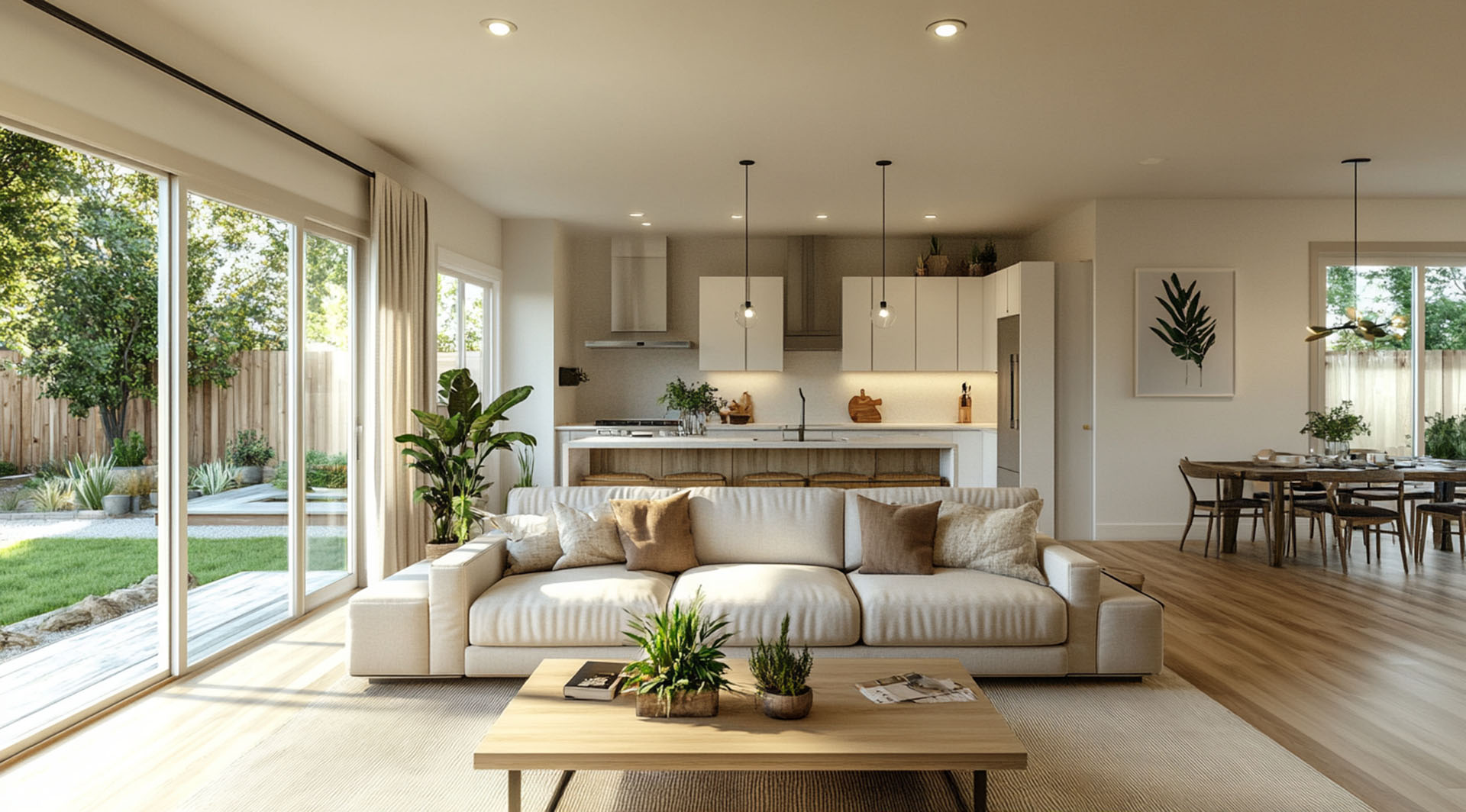
Dubai's climate is the strongest argument for automation done well. For five months of the year the sun is an adversary, and motorised shading, glazing choice and cooling zones decide whether a glass-walled living room is usable at four in the afternoon. A well-designed villa shades itself progressively through the day, cools the rooms in use rather than the whole envelope, and shifts its lighting as the harsh light outside softens into evening.
Then, from November to March, the equation reverses and the outdoors becomes the point. Terraces, courtyards and gardens carry the life of the house, and the automation follows: exterior lighting scenes, cooled outdoor majlis spaces, pool and landscape control. Motorised louvred roofs over a terrace can close automatically on wind, sand or rain sensors and run on the same system as the rooms inside. The contemporary reinterpretation of regional elements, the majlis above all, pairs naturally with this kind of quiet technology, a subject the studio has written about in its piece on the contemporary majlis in Dubai's ultra-luxury villas.
Energy is part of the same conversation. Cooling dominates a Dubai villa's running costs, and automation is the most effective tool the owner has: occupancy-based climate zones, shading that pre-empts solar gain rather than reacting to it, and monitoring that shows where the load actually goes. None of this needs to be visible, and none of it should be sold as a gadget. It is simply good engineering, designed in from the start, quietly saving money for the life of the house while keeping the rooms comfortable at the hours the family actually uses them.
Ultra-luxury households run on staff, and automation has to be designed for that reality. Access control should distinguish family, staff, contractors and guests without friction. Camera coverage must protect the perimeter while respecting the privacy of the family inside, a line that matters in this region. Guest suites need controls a first-time visitor understands in five seconds. And the system should fail gracefully: a villa that cannot open its blinds because a server is down is not a luxury product.
Data privacy deserves the same attention as physical security. Keep critical functions on local processing rather than cloud dependence, choose suppliers with a serious UAE support presence, and make sure the family, not an integrator, owns the system documentation and credentials at handover.
There is also a discipline of enough. The most common failure in expensive villas is not too little technology but too much of it, specified feature by feature until the house needs a manual. The design answer is to automate what repeats, simplify what a guest touches, and leave everything else alone. A villa that runs three or four beautifully judged scenes per room, morning, day, evening and away, will feel more luxurious than one with forty options no one opens after the first month. Editing the technology is design work of the same order as editing a material palette, and it is where an integrated studio earns its keep.
Sequence is everything. Automation planned early costs a fraction of automation forced in late, and it is the only route to technology that feels native to the home.
The studio's UAE practice carries this scope as part of its integrated design and build work across Dubai and Abu Dhabi. If you are planning a villa, or rethinking one, the right first step is a conversation about how you want the house to live, through the enquiry page.
There is no single figure because scope varies enormously, from lighting scenes in principal rooms to full estate automation with integrated shading, AV, security and plant control. At the ultra-luxury tier it is specified and priced per project as part of the overall design and fit-out, and planning it early in design costs far less than adding it late.
KNX, Crestron, Lutron and Control4 can all run a large villa well. Choose a wired backbone, prefer open standards for longevity, and judge integrators on villa-scale references and local support. The quality of the design brief behind the system matters more than the brand on the keypad.
Yes, but with limits. Wireless lighting, shading and security layers can be added with modest disruption, while fully concealed wired systems need chases, ceiling access and shading pockets that are only clean during a genuine renovation. The best results come when automation is planned into a wider redesign.
Yes. Smart home design is one of the practice's core services, delivered inside its integrated model alongside architecture, interiors, lighting, furniture and landscape, so the technology is resolved within the design rather than applied after it. The studio works across Dubai and Abu Dhabi as well as India.
Devices date; infrastructure need not. A villa with a wired backbone, open protocols and properly documented systems can absorb two decades of device change without rebuilding. Obsolescence is mostly a symptom of closed systems and poor documentation, both avoidable at the design stage.
Aparna Kaushik is one of India's foremost architects, recognised among the country's top five for her work on ultra-luxury private residences. With over 18 years of practice and a studio founded in 2008, she has completed landmark estates across India and is now working with UHNW clients in the UAE. Her work blends European classicism with modernist tropical architecture — a sensibility shaped by India's design heritage and executed to a standard that is increasingly sought by Dubai's most discerning villa owners.
aparnakaushik.com/about-us | enquiries@aparnakaushik.com | @aparnakaushikofficial