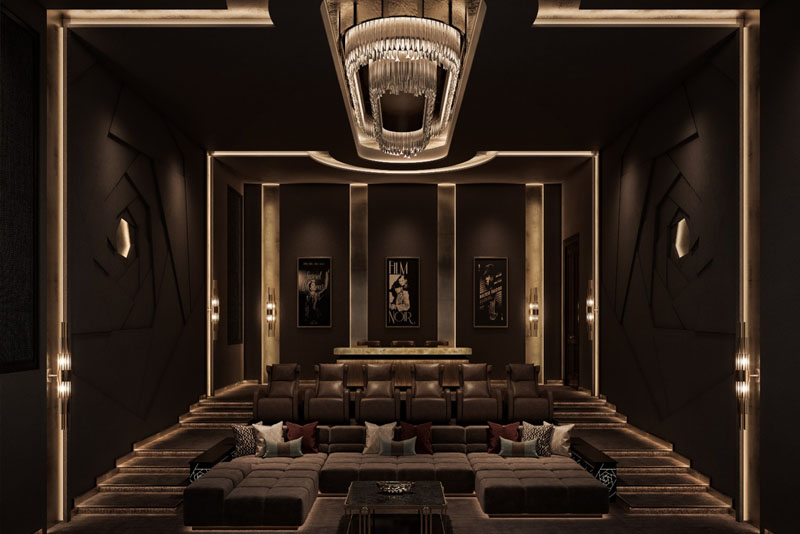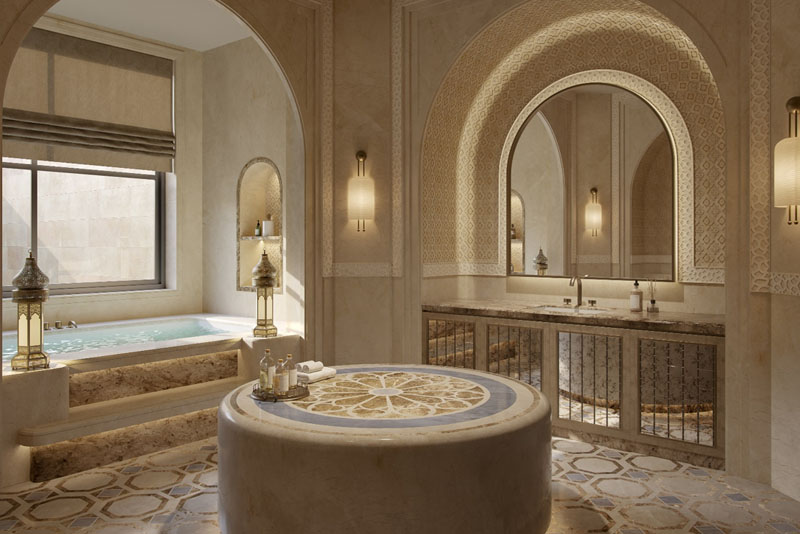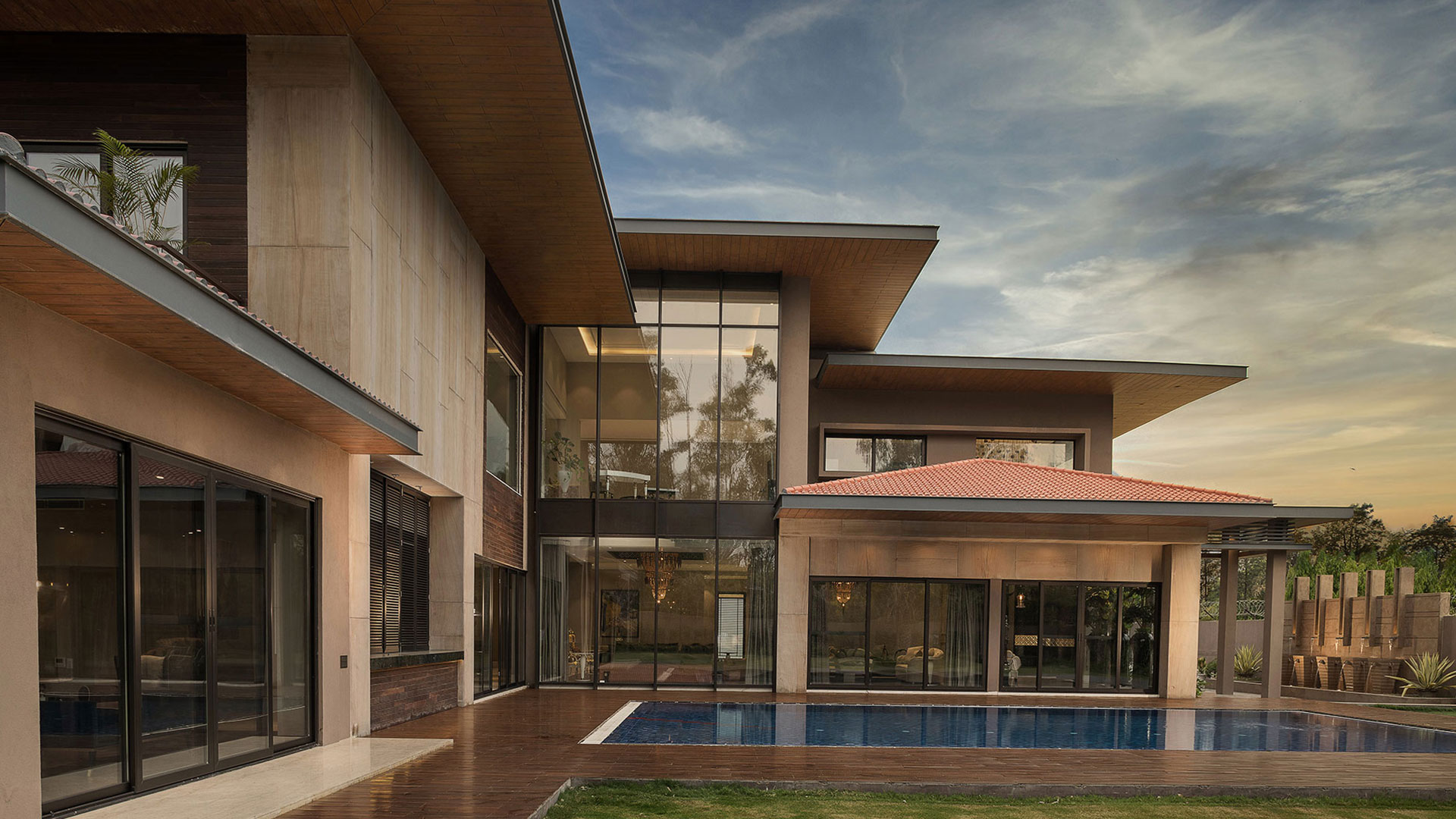
The Panther House is a 15,000 sq. ft. contemporary villa in Delhi, designed by Aparna Kaushik Design Group. Conceived with intertwined design and architectural schemes, building is a direct response to the site, the family's brief, and the specific conditions of Delhi.
KEY TAKEAWAYS
15,000 Sq FtTotal built area Delhi, India |
100%Architecture + interiors as one act No design handoff |
18+Years designing estates at this level Founded 2008, New Delhi |
Top 5Architects in India Recognised across multiple publications |
| Specifications | DETAIL |
|---|---|
| Project Name | The Panther House |
| City | Delhi, India |
| Built Area | 15,000 sq ft |
| Project Type | Ultra-luxury private villa - architecture and interior design |
| Architect and Interior Designer | Aparna Kaushik Design Group |
| Design Approach | Architecture and interior design developed by one team from day one of the brief |
| Key Programme | Primary family residence with private gardens, pool terrace, and entertainment zones |
| Facade Material | Natural stone with recessed glazing -- selected for Delhi's specific climate conditions |
The Panther House, at its core, is a sophisticated simplification of how harmoniously we can design for a multigenerational dialogue, rather than creating silos that divide the house by functional usage or age. The family-owned land parcel has been a long-standing witness to the development of the city and the evolution of multiple generations of the family. The ask was not demanding, but it was challenging, as the family needed more than a spatial configuration. They required a timeless object of design: a physical manifestation of their familial narrative that could hold its stance for another two decades.
They were not interested in a showpiece; they wanted a home that belonged to them specifically. The project, therefore, proceeded as a linear progression of developmental stages that effortlessly moved between interior design requirements and simultaneous architectural decisions. For the design team, this back-and-forth was the best approach for shaping a project as elaborate and expansive as 15,000 sq. ft.
"We spend a long time with a family before we start drawing. We need to understand how they actually live, not just what they want the house to look like. The Panther House in Delhi grew entirely from that listening."
- Aparna Kaushik, Founder and Principal Architect, Aparna Kaushik Design Group
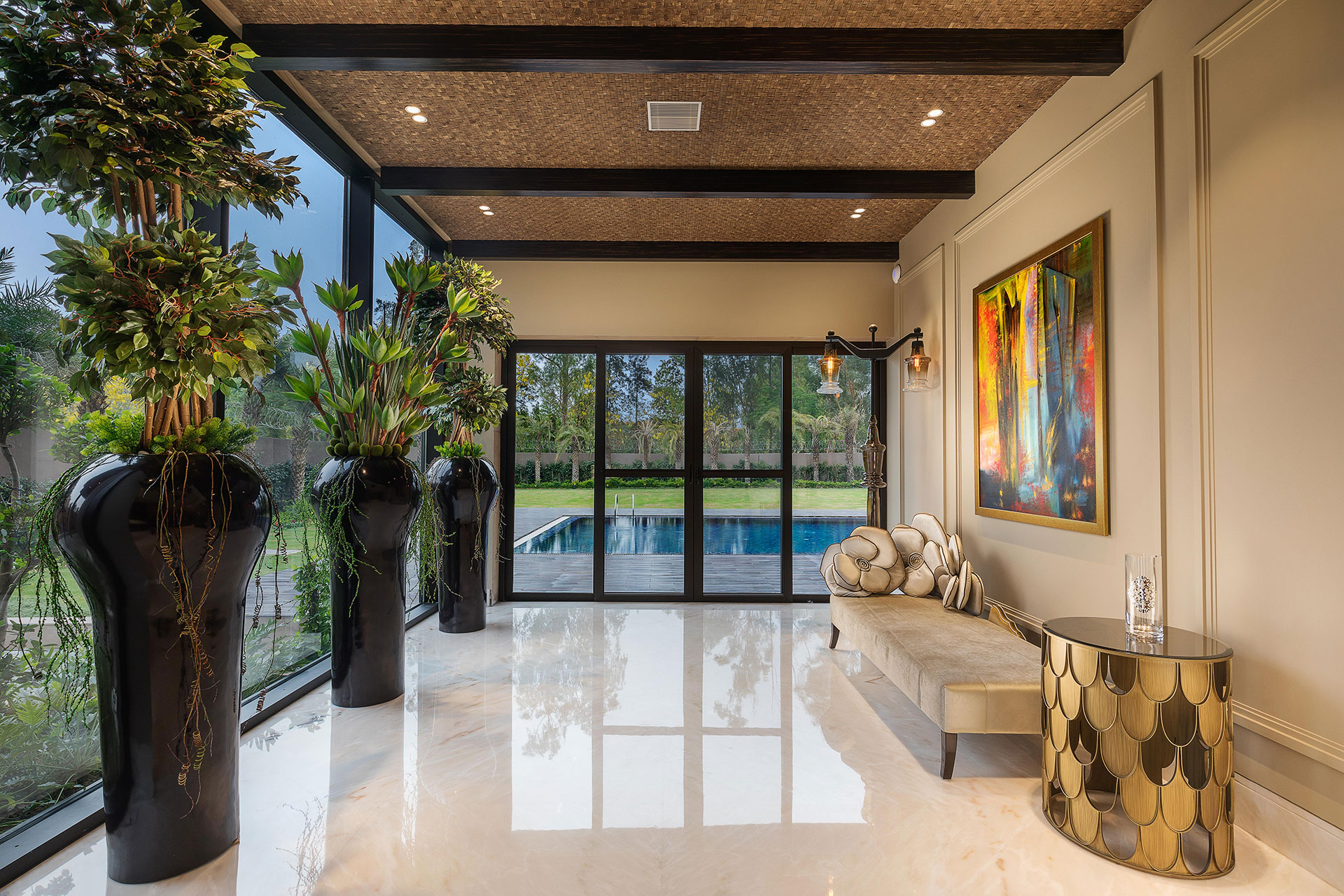
Delhi has three distinct light conditions throughout the year. Summer brings direct, overhead light from above; monsoon light is diffuse and silver; and winter mornings produce a low, amber light from the southeast that is specific to this city. At the Panther House, every structural decision responds to one of these three conditions.
The primary living spaces on the ground floor face east and west. Morning light falls where the family starts their day, while the evening amber light falls on the spaces where they gather. The pool terrace is oriented to catch the forgiving evening hour when the temperature drops and the stone facade shifts from grey to warm.
The window proportions are not mere aesthetic decisions. The overhangs are calculated based on sun angles for Delhi's latitude; they block direct summer solar gain while allowing in winter and morning light. The natural stone on the exterior absorbs heat during the day and releases it slowly overnight, which reduces the thermal load on the building. This climate-responsive design, so conversant with the envelope in which it sits, goes beyond simple visual application.
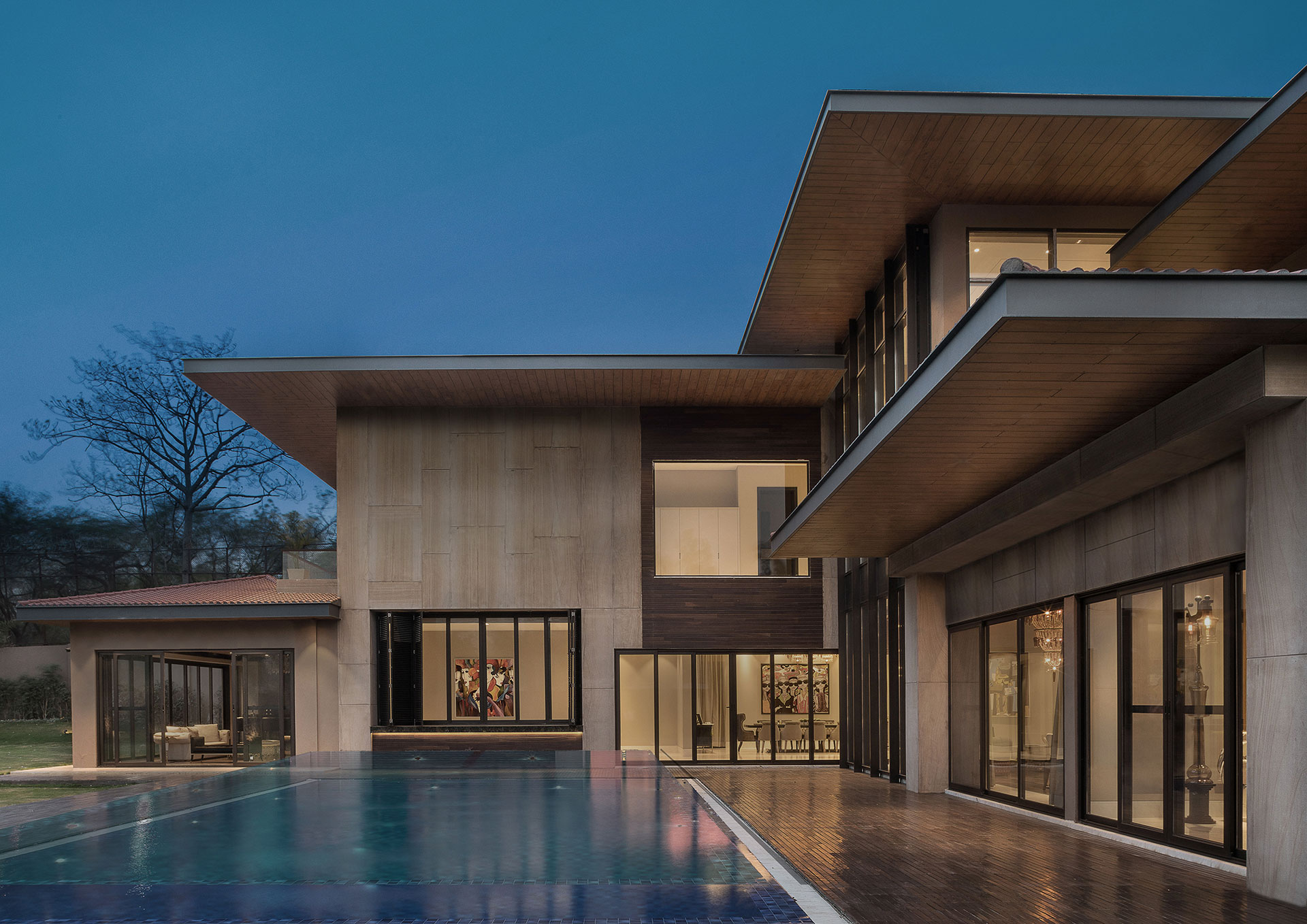
The footprint of the residence runs in an articulated progression as the horizontal volumes unfold. There is a wonderful play of light and shadow that creates a dramatic performance throughout the day.
The stone is warm-toned and textured, strategically chosen for enduring performance. It holds moisture through the monsoon and releases it slowly, thereby aging elegantly. Its tone modulates throughout the day, giving the building a different presence at different hours.
The stone-paved court and the lush green cover prepare the threshold and anyone entering for a wonderfully unhurried entrance. Reminiscent of the opulence of a Parisian boulevard, the arrival pre-empts the luxe factor that is to follow. "The facade is not a skin applied to a building. It is outside of the building. Before it responds to anything aesthetic, it has to respond to rain, heat, dust, and the specific quality of Delhi's light."
-- Aparna Kaushik
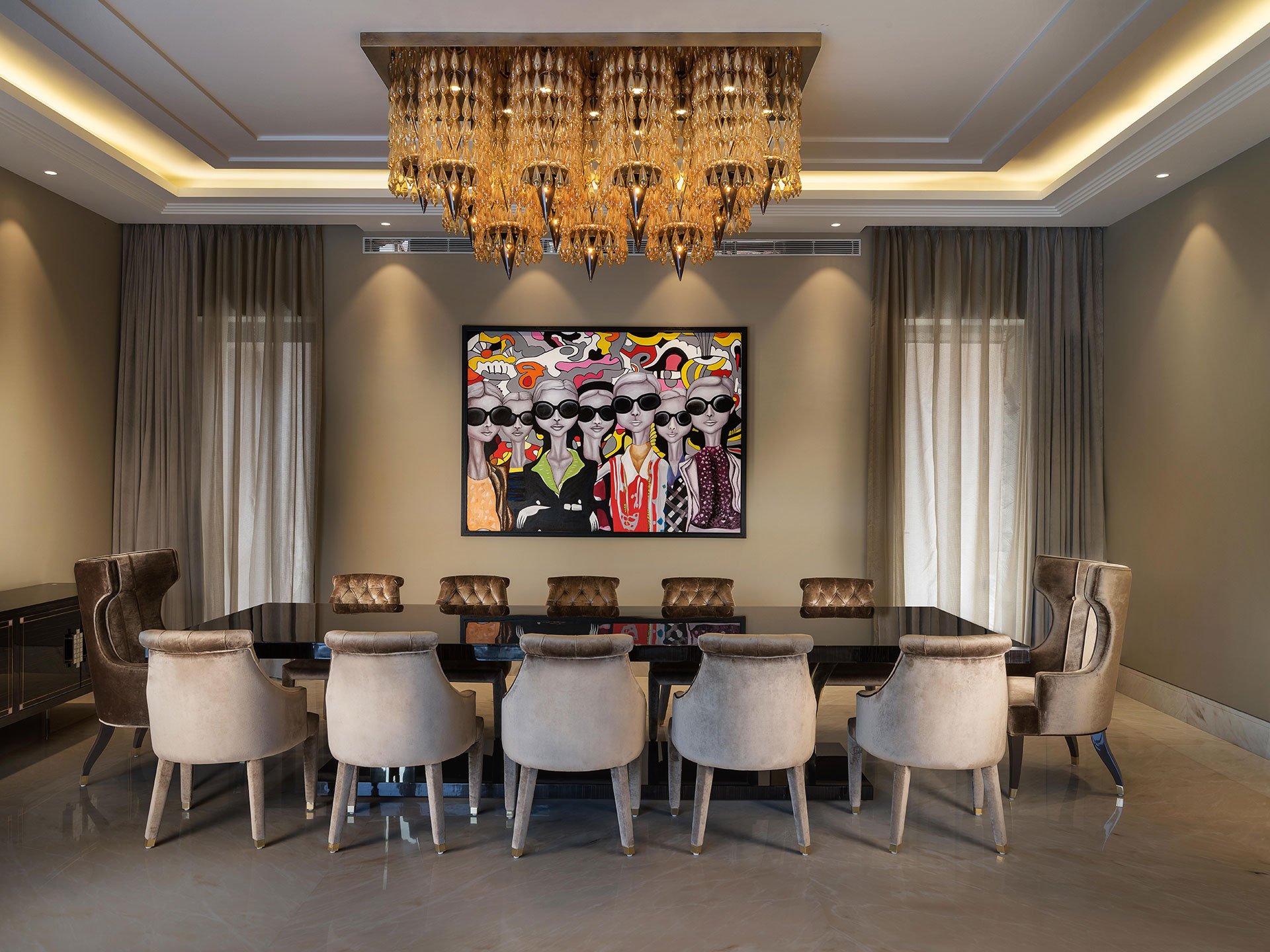
The primary challenge in a private villa of this scale is not the program; it is making sure the size of the building does not weigh on the people who live in it. A home that announces its own scale has failed in its basic function.
The ground floor of the Panther House holds all social life: the living room, dining room, formal reception, and kitchen. Each opens to the pool terrace and gardens. They are connected without being the same space; you move between them naturally without feeling directed.
The upper floors hold private life: bedrooms, studies, and a dedicated wellness zone. The staircase connecting the two levels is a double-height volume that draws natural light down from above. It marks the shift between the social ground floor and the private upper floors in a way that a functional staircase enclosed in a shaft does not.
Service circulation runs entirely separately. The domestic staff and the family do not share corridors, yet the kitchen connects to every zone of the house. This is a practical luxury that large private residences in Delhi often get right in the brief but wrong in execution. At the Panther House, it was designed into the structure from day one. Acoustic separation is structural; it is not managed later with furnishings or soft materials.
An insight into how we approached many other luxe residences through here Interior Design by AKDG.
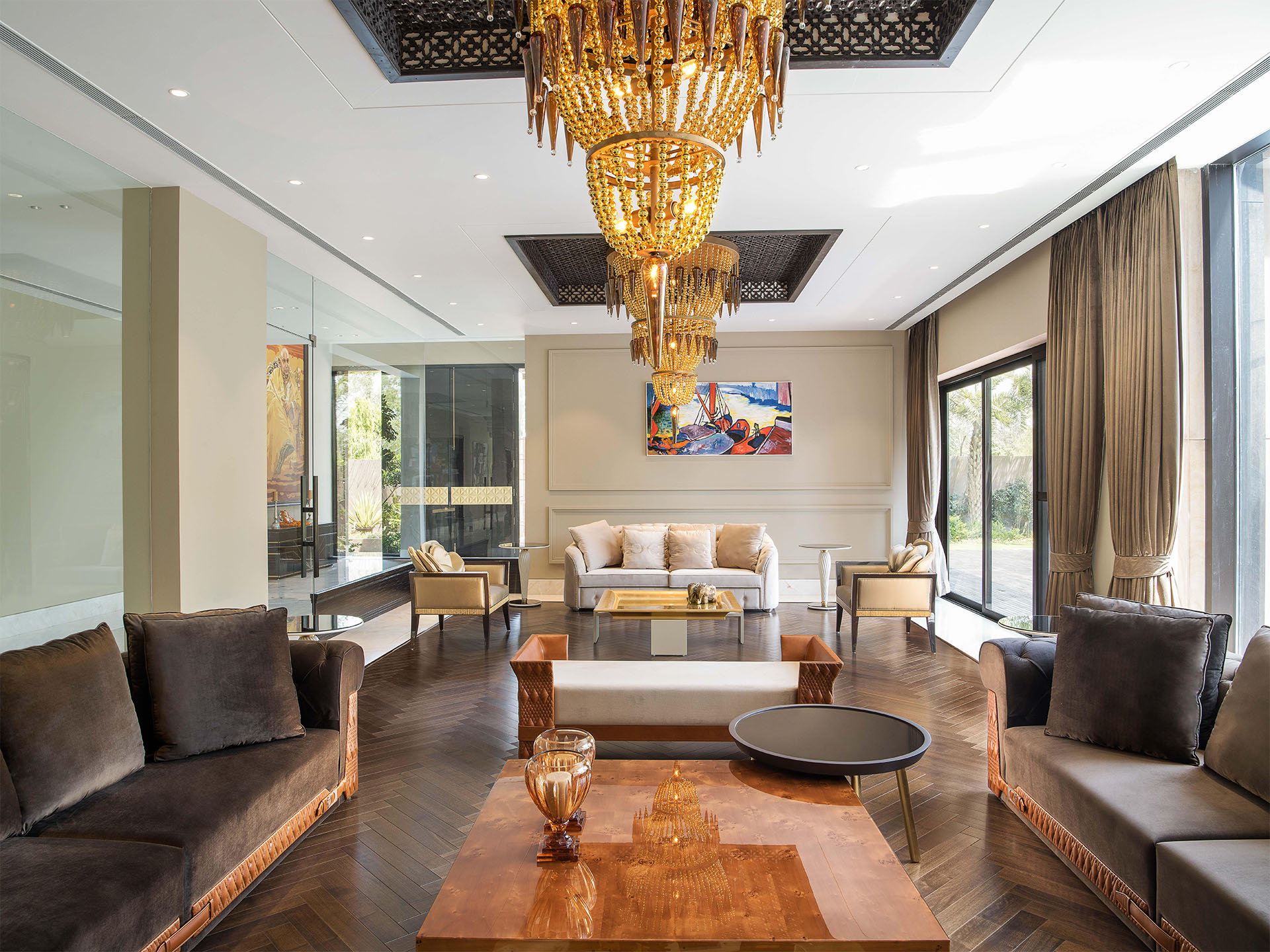
A distinctive and defining method for which the design is celebrated is its textural minimalism. In design processes that retrofit a preconceived architectural shell or follow an interior-first approach, such honouring of textural nuances through design features would not be possible.
For the interior spaces, the use of natural stone begins at the entrance hall, continues across the living room floor, and is picked up by the pool terrace material palette until it reaches the outside again. Thus, the building and its interior share a similar grammar.
Warm timber joinery sits against the stone in rooms that require softening. Bedrooms are warmer; studies are quieter. The main living areas hold the two materials in balance. Designed as a shell that paves the way for its interiors to take centre stage, the Panther House knows its way around both daylight and artificial lighting. Throughout the day, the light is designed to serenade the openness of the design amidst the urban humdrum, while the warmly lit evening lights bring a much-deserved emphasis to the interior elements without screaming pompously.
The design team preferred to take complete charge of the furniture, fixtures, and fittings. When a furniture element is outsourced, it can interject as a form of dissonance within an otherwise harmonious dynamic. Every element must work in perfect tandem: both conceptually and dimensionally.
The courtyard terrace and the approach are the arms leading up to the spaces of enclosure. Often, when a footprint is expansive, the resultant designs are fragmented and independently operational. The Panther House, however, takes a different approach.
As is often the case, the landscape or outdoor elements are among the last to be developed and frequently struggle to find a central focus. That certainly is not the case here. The homogeneous integration of the garden space with the pool deck is seamless and fluid, making it a singular outdoor entity. This pool deck is deliberately flush with the floor level, allowing an uninterrupted flow of spaces into one another. A shared stone floor stretches from the internal spaces to the outdoors, materializing the concept of an integrated cabana.
The trees were chosen for their canopy, not just their appearance. They provide shade during Delhi's summer, filter dust, and reduce the acoustic connection to the city outside the site. They were planted
according to the proportions of the mature trees they will become in ten years, rather than the proportions of the nursery stock at the time of planting.
Outdoor living in a contemporary villa in Delhi works when it is designed with the same rigor as the interior. At the Panther House, that is exactly how it was approached. To see The Panther House and other completed projects: View the full project portfolio.
The table below documents the primary materials used in The Panther House, with notes on finish, application, and why each was specified.
| MATERIAL | FINISH | USED IN | WHY SPECIFIED |
|---|---|---|---|
| Natural Stone (facade) | Warm-toned, honed | Exterior cladding, entrance hall, pool terrace floors | Selected per Delhi's thermal conditions. The mass moderates interior temperature and responds to light differently at each hour of the day. |
| Honed Stone (interior) | Smooth, matte | Primary living room and dining room floors, kitchen surfaces | Continuous usage from exterior to the interior spaces – the single most important material continuity in the project. |
| Timber Joinery | Oiled matte | Cabinetry, wall panelling, staircase cladding | Introduces warmth against the dominance of stone. Every piece custom-designed to the room’s specific proportions. |
| Recessed Glazing | Frameless / minimal framing | All primary facades, pool-facing wall, double-height stair volume | Deep shadow reveals in facade protect interior from summer solar gain while maximising winter and morning light. |
| Aged Brass / Bronze | Unlacquered | Door hardware, lighting fixtures, bathroom fittings | Patinas gracefully over time – the single most important difference between luxury and ultra-luxury hardware specification. |
| Micro-cement | Seamless, matte | Bathrooms, wet rooms, utility transitions | Zero grout lines – fluid surfaces that age well in Delhi's variable humidity. |
| Natural Textiles | Woven - bespoke | Upholstery, curtains, bedding, rugs (all custom) | Softens the stone-and-timber palette. All textiles custom-woven to the specific dimensions and light quality of each room. |
The Panther House is a 15,000 sq ft contemporary private villa in Delhi, designed by Aparna Kaushik Design Group. It is a fully integrated architectural work - architecture and interior design conceived as one act - and one of the practice's most recognised residential projects.
The Panther House is located in Delhi, India. The precise location is not disclosed for client privacy, as is standard for all private residential commissions by Aparna Kaushik Design Group.
The Panther House has a built area of 15,000 sq. ft. At this scale, the primary design challenge is ensuring that the home never feels its size - that every space feels exactly right for how it is lived in.
The Panther House was designed on the principle that architecture and interior design are one act, not two. The material palette, spatial hierarchy, and quality of light were all determined at the structural level - not resolved later through interior choices. This integration is the defining quality of the project.
The primary material is natural stone - warm-toned, honed, continuing from the exterior facade through the interior floors and out onto the pool terrace without interruption. Timber joinery, unlacquered brass hardware, and bespoke textiles complete the palette.
Yes. Aparna Kaushik Design Group designs ultra-luxury private residences across India and in the UAE. To discuss a commission, contact enquiries@aparnakaushik.com or visit aparnakaushik.com.
The Panther House, right from its entrance porch, sets a notable presence for what is to follow. Through its staggering volumes and a horizontality that aims to meld with the outdoors, the architectural form is intentionally shrouded to achieve homogeneity with the internal spaces. Its meticulously detailed spatial nuances take cues from a narrative of timelessness for the multigenerational family, which further informs the spatial planning. This resulted in a series of soulful spaces and a cohesive design that does not respond to fleeting trends, but instead offers a sense of everlastingness.
At 15,000 sq. ft. in Delhi, the Panther House could have been many things. It is, instead, exactly one thing: a home that could not have been designed for anyone else, anywhere else. This specificity, achieved through the integration of architecture and interior design as a single act, is what imbues each of its spaces with timelessness. See the full project: aparnakaushik.com/projects/project-panther-house
Aparna Kaushik is one of India's foremost architects, recognised among the country's top five for her work on ultra-luxury private residences. With over 18 years of practice and a studio founded in 2008, she has completed landmark estates across India and is now working with UHNW clients in the UAE. Her work blends European classicism with modernist tropical architecture — a sensibility shaped by India's design heritage and executed to a standard that is increasingly sought by Dubai's most discerning villa owners.
aparnakaushik.com/about-us | enquiries@aparnakaushik.com | @aparnakaushikofficial