KEY TAKEAWAYS
Most pieces about luxury villa interior design in Dubai discuss the brief: home spa, wine cellar, dressing rooms, the material palette, the design register. While this conversation brings an intentionality to the project, the AKDG Design Journal sets it out separately.
The companion piece, Luxury Villa Interior Design in Dubai: The UHNW Brief for Palm Jumeirah, Emirates Hills, and MBR City , documents the design content of the brief in detail. This piece sets out the operational realities of commissioning a bespoke villa in Dubai, the regulatory and procedural specifics that do not exist in the same form anywhere else in the world.
The reason why it matters is because Dubai’s bespoke villa market is structurally different from London, Mumbai, Singapore, or New York. The villa is not a freestanding architectural commission. It sits inside a master-planned community, controlled by a private master developer, governed by a layered approvals stack, and often operated by someone who lives in another country. A studio that produces a beautiful design without navigating this operational landscape produces a project that takes twice as long, costs significantly more, and arrives with friction the family did not anticipate.
This piece sets out, in detail, the operational mechanics of commissioning a bespoke villa interior design project in Dubai for a UHNW owner in 2026. The master developer landscape and what each one controls. The off-plan timing decision. The Dubai-specific approvals stack. Cross-border project management. And the cost framework when all of this is accounted for. AKDG's view of how the practice structures these commissions is documented across the integrated services framework.
Three structural realities of Dubai's residential market shape every bespoke villa commission, and they do not apply in the same form in any other major luxury market.
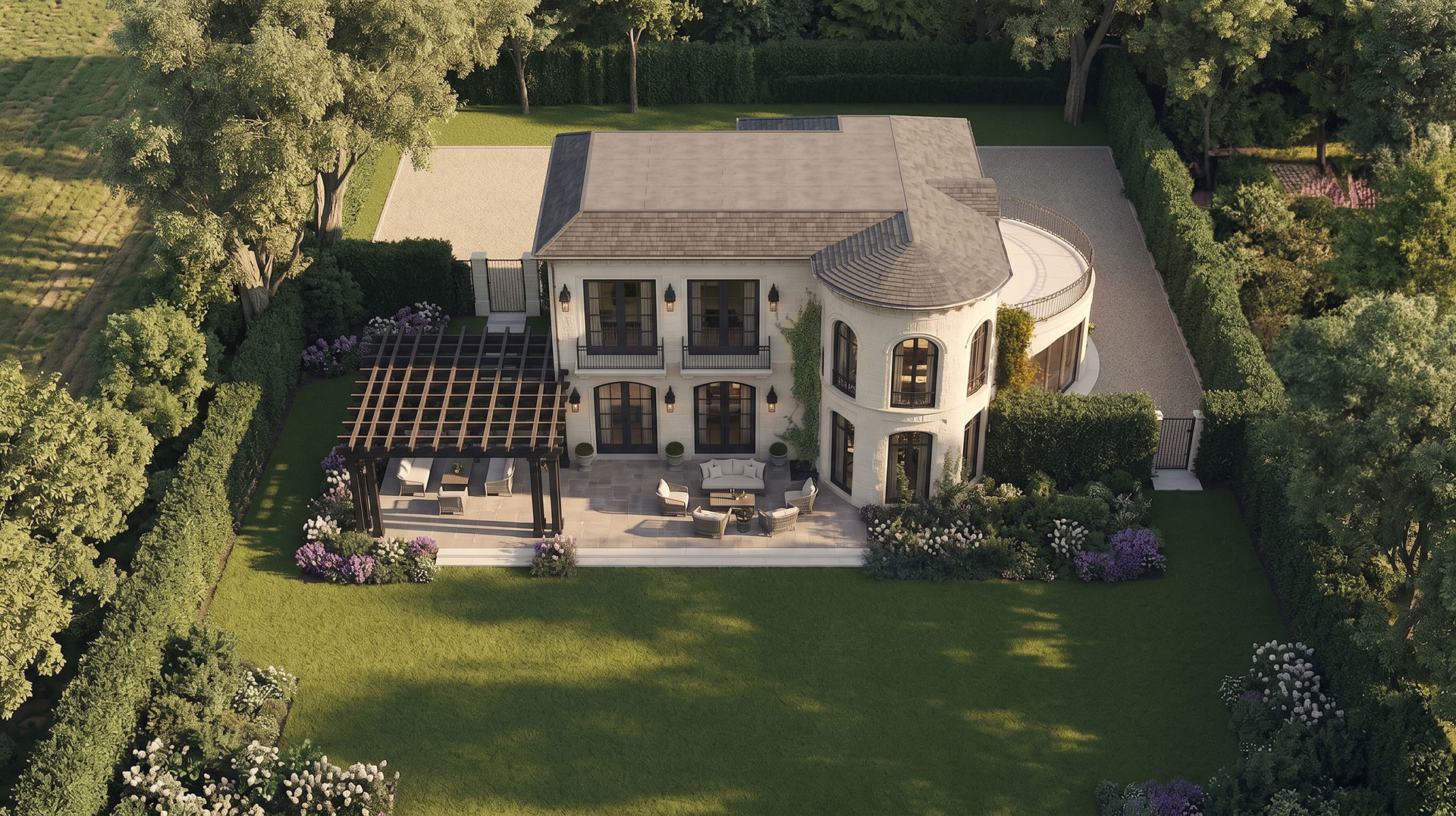
Almost every prime villa district in Dubai is owned and master-planned by a private developer. Palm Jumeirah and Palm Jebel Ali are Nakheel's. Emirates Hills, Dubai Hills Estate, Arabian Ranches, and The Oasis are Emaar's. District One in Mohammed Bin Rashid City is Sobha (in partnership with Meydan). Tilal Al Ghaf is Majid Al Futtaim's. Damac Hills and Akoya are Damac's. The master developer publishes architectural codes that govern plot ratios, building heights, setbacks, materials permitted on facades, and external colour palettes. A bespoke villa commission that does not begin with a thorough reading of these codes will be redesigned at the approvals stage.
According to Savills Middle East's Dubai Prime Residential Market report, off-plan villas accounted for 51 percent of all AED 10 million-plus transactions in 2025. This is unique to Dubai at this scale. In most luxury markets, the UHNW villa is acquired ready-built; in Dubai, more than half are bought off-plan, with handover scheduled 18 to 36 months out from the purchase contract. The bespoke interior designer must therefore be appointed at the off-plan stage rather than after handover, in order to influence shell-stage decisions (room dimensions, ceiling planes, glazing positions, MEP routing) before they are locked in. Studios appointed only after handover are working around constraints that a six-month-earlier appointment would have removed.
A bespoke villa commission in Dubai requires sequenced approvals from Dubai Municipality (the building permit through the Trakheesi platform), the master developer (a No Objection Certificate, or NOC, before any DM submission), Dubai Civil Defence (fire and life safety), DEWA (electricity and water), and Etisalat or du (telecoms). Some districts require additional approvals: District Cooling permits from Empower, JOPD authority for jointly owned developments, and freehold zone confirmations from the Dubai Land Department. The stack runs in a specific sequence, and each layer can introduce 4 to 12 weeks of programme delay if approached out of order.
Five master developers control the majority of Dubai's prime villa districts. Each operates a distinct architectural code, NOC process, and design review timeline. Understanding which developer controls a given plot is the first thing a bespoke commissioning studio establishes after appointment.
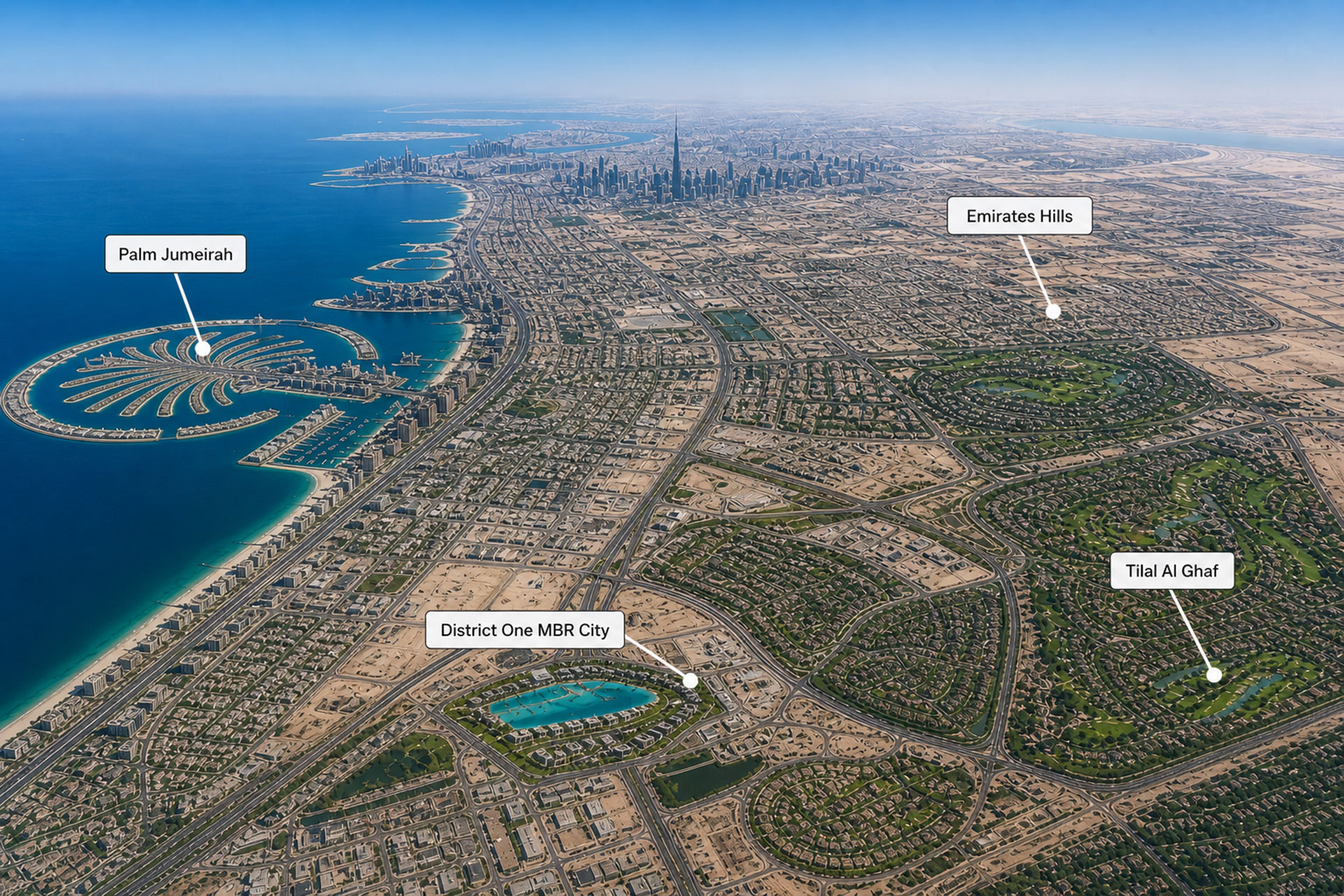
Nakheel governs Palm Jumeirah, the most active prime villa district in Dubai (AED 19.38 billion in AED 40 million-plus sales over five years, 31 percent of the trophy market). The Nakheel architectural code on the Palm restricts external facade alterations on Signature Villas, Garden Homes, and Frond Villas, and requires NOCs for any modification visible from the public realm. Renovation programmes that extend beyond pure interior work, including external pergolas, roof terrace additions, or facade reconfigurations, require formal Nakheel design review before DM submission. Palm Jebel Ali, currently in delivery, will operate under a similar code.
Emaar governs the largest portfolio of prime villa communities in Dubai. Emirates Hills (AED 9.04 billion in AED 40 million-plus sales, 15 percent of the trophy market) operates under a strict design review process for any new build or major renovation, with particular attention to consistency with the Montgomerie golf-course-fronting elevation language. Dubai Hills Estate, Arabian Ranches, and The Oasis (the newest Emaar prime district) each have distinct architectural codes; Emaar's design review process is generally more standardised than Nakheel's but operates on similar timelines.
District One within MBR City is delivered by Sobha in partnership with Meydan. Trophy villa transactions here account for AED 6.40 billion and 10 percent of Dubai's AED 40 million-plus market. The architectural code is more contemporary than Emaar's classical Emirates Hills register and permits a wider range of contemporary architectural language. Sobha's NOC process for villa renovations and bespoke interior commissions runs in parallel with Meydan's approval workflow.
Tilal Al Ghaf, currently scaling rapidly with AED 3.6 billion in transactions since 2023, is delivered by Majid Al Futtaim. Meraas governs City Walk, La Mer, and parts of Bluewaters, with selective trophy villa transactions. Damac governs Damac Hills and Akoya. Each operates a separate NOC process. For UHNW buyers acquiring across multiple districts, the practical implication is that a single bespoke commission across two villas in different Dubai districts is, in operational terms, two separate approvals projects with two separate master developer relationships.
If the villa is being acquired off-plan, the timing of the interior designer appointment is the single most consequential operational decision the family will make. The default behaviour, appointing after handover, costs both time and money. The disciplined behaviour, appointing at off-plan contract stage, produces a substantially more integrated final villa.
| # | Phase | Duration | Dubai-Specific Operational Notes |
|---|---|---|---|
| 1 | Discovery and brief development | 3 to 6 weeks | Principal-led conversations with the family. For cross-border families, this typically combines on-site visits in Dubai with secondary meetings in the family's home country (commonly India, UK, Singapore, or KSA). |
| 2 | Plot, code, and master developer review | 3 to 5 weeks | Architectural code review for the specific master developer (Nakheel, Emaar, Sobha, Meraas, Majid Al Futtaim, Damac). Plot ratio, height, setback, facade restrictions, NOC requirements documented before any concept work begins. |
| 3 | Concept presentation | 4 to 8 weeks | Coherent design concept presented to the family, with the master developer code already factored in. Common practice now is to share a draft of the concept informally with the master developer's design review team to flag any code conflicts before formal NOC application. |
| 4 | Design development and master developer NOC | 16 to 24 weeks | Full architectural and interior drawings developed in parallel with the master developer NOC submission. Joinery, ceiling plans, MEP coordination, lighting plans, material library finalised. The NOC must be issued before DM submission can proceed. |
| 5 | DM Building Permit, Civil Defence, utilities | 8 to 16 weeks | DM Building Permit through Trakheesi. Civil Defence approval for fire and life safety. DEWA and Etisalat or du connections. Empower district cooling permits where applicable. Long-lead bespoke materials ordered (stone, custom joinery, hand-loomed textiles). |
| 6 | Sourcing and import logistics | Parallel, 32 to 56 weeks | Direct sourcing from quarries, mills, workshops outside the UAE. Free Zone routing for material imports where appropriate. UAE customs clearance, GCC standards compliance, GCC-compliant labelling. International logistics aligned to site sequencing. |
| 7 | Construction, fit-out, supervision | 56 to 88 weeks | On-site execution. Principal-led design supervision, including remote supervision tools for cross-border owners. Material installation, joinery, lighting, MEP commissioning, smart home integration. Final art installation and styling. |
| 8 | Handover, snagging, and aftercare | 4 to 8 weeks + ongoing | Final snagging, defect resolution, family walkthrough. JOPD authority sign-off where applicable. Smart home training and maintenance protocols. Most established practices maintain a 1 to 2 year aftercare relationship covering material performance and authority compliance. |
The single most common cause of programme slippage in Dubai bespoke villa commissions is approvals that have been pursued out of sequence. The stack below sets out the standard order for a bespoke villa project at the AKDG tier.
| # | Approval | Typical Time | Why It Matters |
|---|---|---|---|
| 1 | Master developer NOC | 4 to 12 weeks | Issued by Nakheel, Emaar, Sobha, Meraas, Majid Al Futtaim, or Damac depending on the district. Required before DM submission. Reviews architectural alterations against the master developer's published code. |
| 2 | Dubai Municipality Building Permit | 4 to 10 weeks | Submitted through Trakheesi. Covers structural alterations, MEP modifications, change of internal layout, external pergolas, swimming pool, hardscape. The DM Building Permit is the primary regulatory consent for the project. |
| 3 | Dubai Civil Defence | 3 to 6 weeks | Fire and life safety review. Covers fire detection, fire suppression, escape routes, emergency lighting, smart home fire integration. Required for occupancy. |
| 4 | DEWA (electricity and water) | 3 to 8 weeks | Connection upgrades for additional load (home spa, cinema, smart home, EV charging) often require DEWA load capacity review. Substation upgrades may be required for villas with heavy electrical specification. |
| 5 | Empower (district cooling) | 2 to 6 weeks | Required in districts on Empower district cooling (parts of MBR City, Business Bay, Downtown). Covers cooling load adjustments and connection modifications. |
| 6 | Etisalat or du (telecoms) | 2 to 4 weeks | Fibre, voice, and security connections. Smart home systems require dedicated infrastructure. Upgrades coordinated alongside the main fit-out. |
| 7 | JOPD authority (where applicable) | 4 to 8 weeks | Jointly Owned Property Declaration approval, applies in some MBR City sub-districts and other JOPD-governed communities. Required where common-area or shared-services modifications are part of the brief. |
| 8 | Dubai Land Department (DLD) | Varies | Title transfer, freehold zone confirmation for non-citizen ownership, golden visa real estate documentation. Coordinated with the family's legal advisors rather than the design studio directly. |
The most disciplined practice is to map this stack at the design development stage and update it weekly through the project. Approvals delays are the single largest avoidable cause of cost overrun in Dubai bespoke villa commissions.
Roughly 88 percent of Dubai's residents are non-citizens, be it the UK, Singapore or India. The UHNW villa owner commissioning a bespoke project in Dubai is, in most cases, managing the commission across borders. The studio appointed must structure the engagement for this reality, not for the assumption of a daily on-site client presence.
A significant proportion of Dubai's UHNW villa buyers are of Indian origin (NRI families, Indian business owners with Gulf operations, Indian-origin global citizens). For these clients, design continuity between Indian and UAE residences is structural rather than aspirational. Our editorial on what separates India's top architectural practices sets out the architectural framework that produces this continuity. The same principal-led practice can deliver a Lutyens bungalow renovation in Delhi, a farmhouse build in Chhatarpur, and a Palm Jumeirah villa as a coherent set of related projects rather than three separate appointments.
Bespoke commissioning at this tier requires monthly principal-led design reviews, weekly programme updates, and live site documentation accessible to the family from any location. The most established studios now operate dedicated cross-border project management platforms, with structured fortnightly reviews, video walkthroughs of the site, and clear sign-off gates at each phase. The objective is that a family in Mumbai, London, or Singapore can sign off a stone selection or a joinery detail with the same confidence as if they were on-site.
A bespoke Dubai villa at the UHNW tier typically draws material from multiple geographies. European stone (Italian Calacatta, Greek limestone). Indian craft (Makrana marble, Moradabad brass, hand-loomed textiles). UK or Italian joinery and hardware. North African or Iberian timber. Each material crosses customs into the UAE under specific Free Zone routing, GCC standards compliance, and project-specific clearance protocols. A studio with established import logistics infrastructure typically saves 4 to 12 weeks of programme over a studio operating import on a project-by-project basis.
UHNW Dubai villa commissions are typically paid in AED, USD, GBP, EUR, or INR depending on the family's primary banking arrangement. Payment milestones are tied to design phase completion and approval gates. Dubai's Golden Visa (10-year residency for AED 2 million-plus real estate investment) is increasingly factored into the structuring of the villa acquisition itself, with implications for ownership entity, tax planning, and asset structuring. The bespoke design studio's role is to deliver the project; coordination with legal, tax, and immigration advisors is the family's, but the studio's project programming should anticipate these workflows.
Bespoke villa interior design in Dubai is priced on scope, plot, and master developer context, not on area. The per-square-foot quotes that dominate the broader Dubai market are largely irrelevant at the UHNW tier.
Design fees on a bespoke Dubai villa commission typically run 10 to 20 percent of construction or fit-out value, or are structured as a fixed principal-led retainer for the full project duration. On a villa with a construction budget of AED 30 million, that translates to design fees of AED 3 million to AED 6 million. On a trophy commission with a construction budget of AED 80 million-plus, fees scale proportionally and are frequently structured as a fixed principal retainer rather than a percentage.
Construction and fit-out costs at the bespoke tier in Dubai range from AED 2,500 to AED 6,000 per square foot of built-up area, before bespoke material premiums. A 10,000 square foot villa fitted to this standard typically carries a build cost of AED 25 million to AED 60 million. Off-plan villas, where the developer's shell is being modified during construction, often run 15 to 25 percent higher than equivalent ready villa renovations because of the coordination required between the master developer's contractor and the bespoke design studio's own contractor team.
Furniture, lighting, art commissions, and final styling typically run 15 to 30 percent of construction value as a separate budget. On the AED 30 million villa above, that translates to AED 4.5 million to AED 9 million. The most established practices coordinate this budget in parallel with the build, ensuring pieces are designed and procured for specific spaces rather than selected from existing inventory.
The all-in cost of a bespoke villa commission in Dubai at this tier (acquisition cost excluded) typically lands between AED 35 million and AED 100 million, depending on plot, scale, and depth of bespoke specification. The trophy segment (AED 100 million-plus all-in) requires architectural and craft execution at a different depth still, with single principal rooms frequently carrying material and fit-out budgets above AED 5 million.
Given the operational complexity set out above, the criteria UHNW families should use to shortlist a bespoke interior design studio in Dubai differ in emphasis from the criteria used in any other market. Six markers reliably separate a studio that can navigate Dubai's commissioning landscape from one that cannot.
The studio should have completed projects under at least two of the major master developers (Nakheel, Emaar, Sobha, Meraas, Majid Al Futtaim, Damac) and should be able to articulate the specific NOC processes for each. AKDG's UAE practice page documents the studio's active Dubai capability across Palm Jumeirah, Emirates Hills, and Mohammed Bin Rashid City.
The studio should have a documented track record of appointment at off-plan stage rather than only post-handover. Studios that operate exclusively in the post-handover window will struggle with the off-plan villa segment, which represents 51 percent of Dubai's prime market.
Structured monthly principal-led reviews, weekly programme updates, live site documentation accessible remotely, video walkthroughs, and clear sign-off gates. A studio without this infrastructure is operationally unsuited to UHNW Dubai commissions, where most clients are managing across borders.
Direct relationships with European and Indian quarries, mills, and workshops, plus established Free Zone routing and customs infrastructure for the UAE. New-to-Dubai studios typically lose 4 to 12 weeks of programme to import logistics over established practices.
The lead designer must be personally directing the project at every phase, not delegating after concept. Our framework on how UHNW families shortlist the best architects in Delhi NCR sets out the principal-led standard that applies equally to a Dubai bespoke villa commission.
NDAs from the first conversation. Coded project names internally. Controlled photography rights. Absolute discretion around client identity. UHNW villa owners in Dubai assume this is in place from the outset, and a studio that does not default to it is operating at a different tier of the market.
“Commissioning a bespoke villa in Dubai is not the same project as commissioning a bespoke residence in Delhi or London. The design discipline is comparable. What is different is the operational landscape: the master developer code, the off-plan timing window, the approvals stack, the cross-border project structure. A studio that does not understand all of that will produce a beautiful design that takes twice as long to build. Our job is to make that complexity invisible to the family.”
- Aparna Kaushik, Founder and Principal Architect, Aparna Kaushik Design Group
The most operationally effective appointment timing is at off-plan contract stage rather than after handover. Off-plan villas accounted for 51 percent of all Dubai prime transactions above AED 10 million in 2025. Appointing the interior designer 18 to 36 months before scheduled handover (i.e., at the same time as the off-plan purchase) allows the studio to influence shell-stage decisions including ceiling planes, MEP routing, glazing positions, and core room dimensions before they are fixed by the developer's contractor. Appointing only after handover means the design must work around constraints that an earlier appointment would have removed.
The master developer landscape is: Palm Jumeirah and Palm Jebel Ali (Nakheel); Emirates Hills, Dubai Hills Estate, Arabian Ranches, and The Oasis (Emaar); District One in Mohammed Bin Rashid City (Sobha and Meydan); Tilal Al Ghaf (Majid Al Futtaim); Damac Hills and Akoya (Damac); City Walk and parts of Bluewaters (Meraas). Each operates a distinct architectural code that governs plot ratios, building heights, setbacks, and facade treatments, and each issues NOCs through its own design review process. Your bespoke commission must comply with the specific code of the master developer for your district, and the NOC must be issued before Dubai Municipality submission can proceed.
The master developer landscape is: Palm Jumeirah and Palm Jebel Ali (Nakheel); Emirates Hills, Dubai Hills Estate, Arabian Ranches, and The Oasis (Emaar); District One in Mohammed Bin Rashid City (Sobha and Meydan); Tilal Al Ghaf (Majid Al Futtaim); Damac Hills and Akoya (Damac); City Walk and parts of Bluewaters (Meraas). Each operates a distinct architectural code that governs plot ratios, building heights, setbacks, and facade treatments, and each issues NOCs through its own design review process. Your bespoke commission must comply with the specific code of the master developer for your district, and the NOC must be issued before Dubai Municipality submission can proceed.
The Dubai approvals stack typically includes: master developer NOC (issued first); Dubai Municipality Building Permit through the Trakheesi platform; Dubai Civil Defence approval for fire and life safety; DEWA connection for electricity and water (often requiring load capacity review for villas with home spa, cinema, EV charging, and smart home specification); Empower district cooling permit where applicable; Etisalat or du telecoms; JOPD authority sign-off in jointly owned developments; and Dubai Land Department (DLD) for title and freehold zone confirmation. Each layer requires 2 to 12 weeks. Pursued out of sequence, the stack can add 4 to 8 months to the programme.
Yes, and most UHNW Dubai villa owners do. Roughly 88 percent of Dubai's residents are non-citizens, and the majority of UHNW villa buyers manage their commissions across borders. The studio appointed must structure the engagement for this reality: monthly principal-led design reviews, weekly programme updates, live site documentation accessible remotely, structured fortnightly video walkthroughs of the site, and clear sign-off gates at each project phase. A family in Mumbai, London, or Singapore should be able to sign off a stone selection or a joinery detail with the same confidence as if they were on-site. Studios without this remote oversight infrastructure are operationally unsuited to UHNW Dubai commissions.
A ground-up bespoke villa commission in Dubai typically runs 22 to 36 months. The discovery, design development, and concept phases are comparable to London or Mumbai (6 to 12 months). The Dubai-specific addition is the master developer NOC process (4 to 12 weeks), which precedes the Dubai Municipality Building Permit. Off-plan commissions add a further 6 to 12 months to the total programme because the design proceeds in parallel with the developer's shell construction. A major renovation of an existing Dubai villa runs 9 to 18 months, again with master developer NOC sequencing on top.
Each district has its own published architectural code. Nakheel's code on Palm Jumeirah restricts external facade alterations on Signature Villas, Garden Homes, and Frond Villas, requiring NOCs for any modification visible from the public realm. Emaar's code in Emirates Hills enforces consistency with the Montgomerie golf-course-fronting elevation language and requires design review for any major exterior change. Sobha and Meydan's code in District One MBR City permits a wider range of contemporary architectural language but still requires NOC for structural modifications. The first task of a bespoke design studio appointed to a Dubai project is to obtain and read the specific master developer code that applies to your plot.
Dubai's Golden Visa (10-year residency for non-citizens) is granted at a real estate investment threshold of AED 2 million. At the bespoke villa tier (AED 30 million-plus), the Golden Visa is essentially a default outcome of the acquisition rather than a separate decision, but the structuring of ownership entity, tax planning, and family asset arrangements often shapes the timing and entity through which the design contract is signed. The bespoke design studio coordinates with the family's legal, tax, and immigration advisors rather than handling these workflows directly, but the studio's project programming should anticipate them.
A bespoke Dubai villa at this tier typically draws material from multiple geographies: European stone (Italian Calacatta, Greek limestone), Indian craft (Makrana marble, Moradabad brass, hand-loomed textiles), UK or Italian joinery and hardware, and North African or Iberian timber. Each material crosses customs into the UAE under specific Free Zone routing, GCC standards compliance, and project-specific clearance protocols. A studio with established import logistics infrastructure typically saves 4 to 12 weeks of programme over a studio operating import on a project-by-project basis. Customs clearance is a primary scheduling risk for bespoke material; programme buffers of 2 to 4 weeks per major shipment are standard.
Four bottlenecks recur consistently. First, master developer NOC review for villas in restricted facade districts (Palm Jumeirah Signature Villas, Emirates Hills) can extend to 8 to 12 weeks where the design pushes against the architectural code. Second, DEWA load capacity review for villas with heavy electrical specification (EV charging, home spa, cinema, smart home) can require substation upgrades that add 6 to 16 weeks. Third, Civil Defence review for villas with bespoke acoustic, lighting, or smart home integration can require additional submissions. Fourth, JOPD authority sign-off in jointly owned communities adds 4 to 8 weeks. Disciplined approvals sequencing from the design development stage is the only effective mitigation.
Aparna Kaushik Design Group is an ultra-luxury architectural and interior design practice led by Aparna Kaushik, recognised among India's top five architects. Established in 2008 and headquartered in Noida, the studio operates across India and the UAE, with active bespoke villa commissions across Palm Jumeirah, Emirates Hills, and Mohammed Bin Rashid City in Dubai. The practice has been featured in Architectural Digest India, Elle Decor India, Harper's Bazaar Arabia, Emirates Woman, and Robb Report. AKDG accepts a deliberately small number of bespoke commissions each year to preserve principal-led attention on every project.
A bespoke villa in Dubai at the UHNW tier is, operationally, one of the most demanding architectural commissions in the world. The villa sits inside a master-planned community governed by a private master developer. The acquisition is frequently off-plan. The approvals stack is multi-layered. The owner is most often managing across borders. And the material supply chain runs across multiple international geographies. The studio appointed must navigate all of this while delivering an architectural and interior result that holds up over the next thirty years of family use.
Aparna Kaushik Design Group accepts a deliberately small number of bespoke villa commissions in Dubai each year, with active projects across Palm Jumeirah, Emirates Hills, and Mohammed Bin Rashid City. For UHNW families considering a bespoke villa commission in Dubai, the studio welcomes a direct conversation. The AKDG UAE practice page sets out current Dubai capability in detail, and the portfolio of completed work documents the depth of the practice across India and the UAE.
To discuss a project, please contact our team here, or write to enquiries@aparnakaushik.com.
Aparna Kaushik is one of India's foremost architects, recognised among the country's top five for her work on ultra-luxury private residences. With over 18 years of practice and a studio founded in 2008, she has completed landmark estates across India and is now working with UHNW clients in the UAE. Her work blends European classicism with modernist tropical architecture — a sensibility shaped by India's design heritage and executed to a standard that is increasingly sought by Dubai's most discerning villa owners.
aparnakaushik.com/about-us | enquiries@aparnakaushik.com | @aparnakaushikofficial