KEY TAKEAWAYS
Luxury villa interior design in Dubai in 2026 is a different proposition than it was even three years ago.
The scale-first era, defined by the Palm Jumeirah mega-villas of the 2010s, with ornate facades, double-height drama, and interiors that prioritised visual impact, has quietly given way to something more considered. Owners now expect interiors that read as calm at first encounter, reveal depth through tactile finish and impeccably resolved detail on closer inspection, and accommodate a deep lifestyle programme across home spa, wine cellar, dressing rooms, chef's kitchen, and integrated outdoor living, all without visual noise.
The shift has been driven by the buyer profile. According to Savills Middle East's Dubai Prime Residential Market report, 70% of all AED 10 million-plus transactions in Dubai in 2025 were villas, with a combined 6,000 transactions above the prime threshold. These buyers are globally-travelled, commonly with direct exposure to design markets in London, Milan, New York, and Tokyo. The reference set they bring to a Dubai villa commission is international. The expectation is that the studio appointed will deliver villa interiors that hold their own against that global benchmark, while responding specifically to the architecture, climate, and plot conditions of the Dubai district where the villa sits.
This piece sets out the UHNW luxury villa interior design brief across Dubai's three primary districts: Palm Jumeirah, Emirates Hills, and Mohammed Bin Rashid City. What each district's interior brief actually involves. The material palette that now defines the quiet-luxury register. The cost framework. And how UHNW villa owners commission a bespoke interior designer to deliver it. The companion piece in the AKDG Design Journal, our commissioning guide for UHNW bespoke villa owners in Dubai , sets out the underlying commissioning process in greater operational detail.
Three structural shifts have reshaped what luxury villa interior design actually looks like at Dubai's UHNW tier.
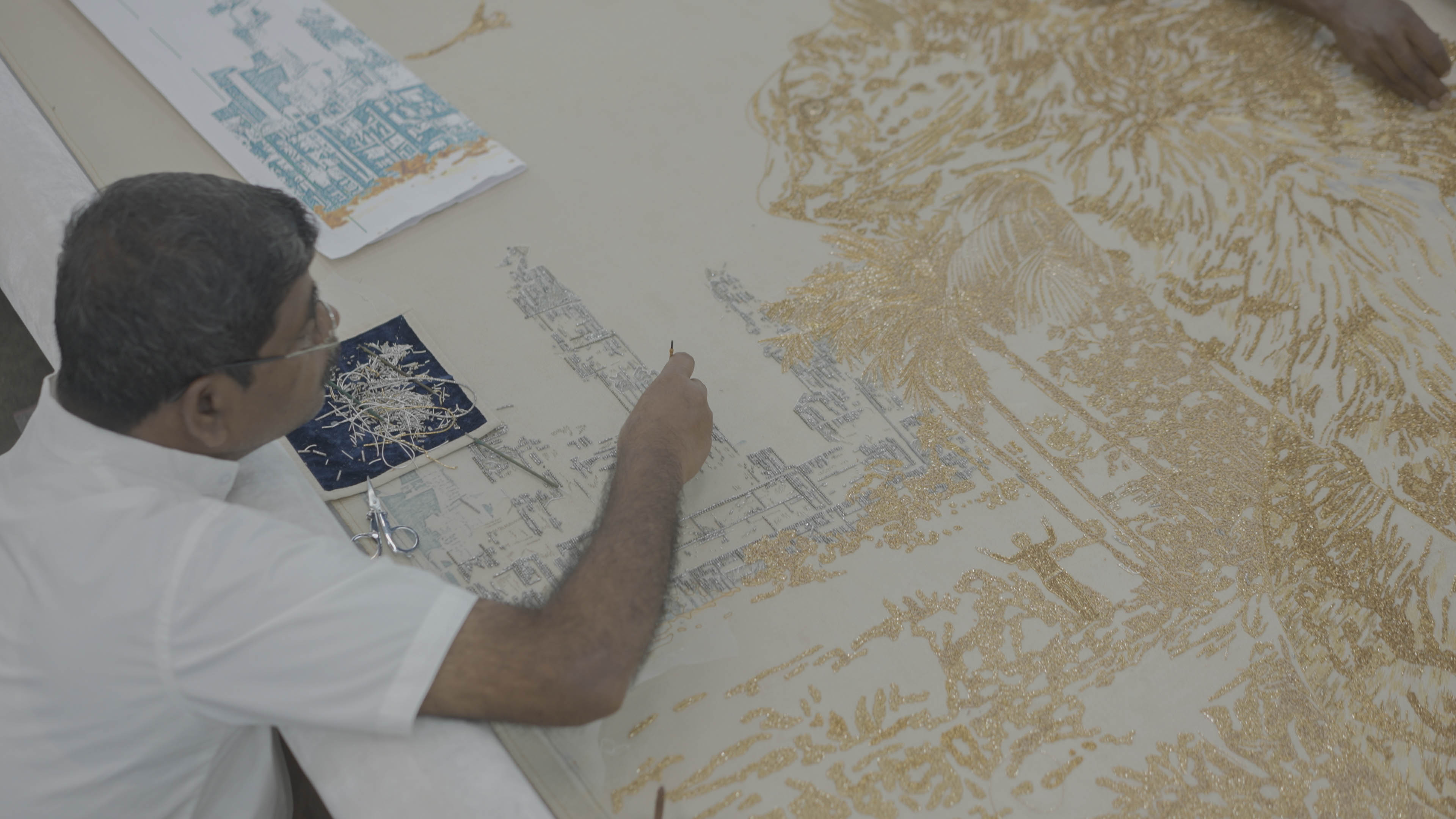
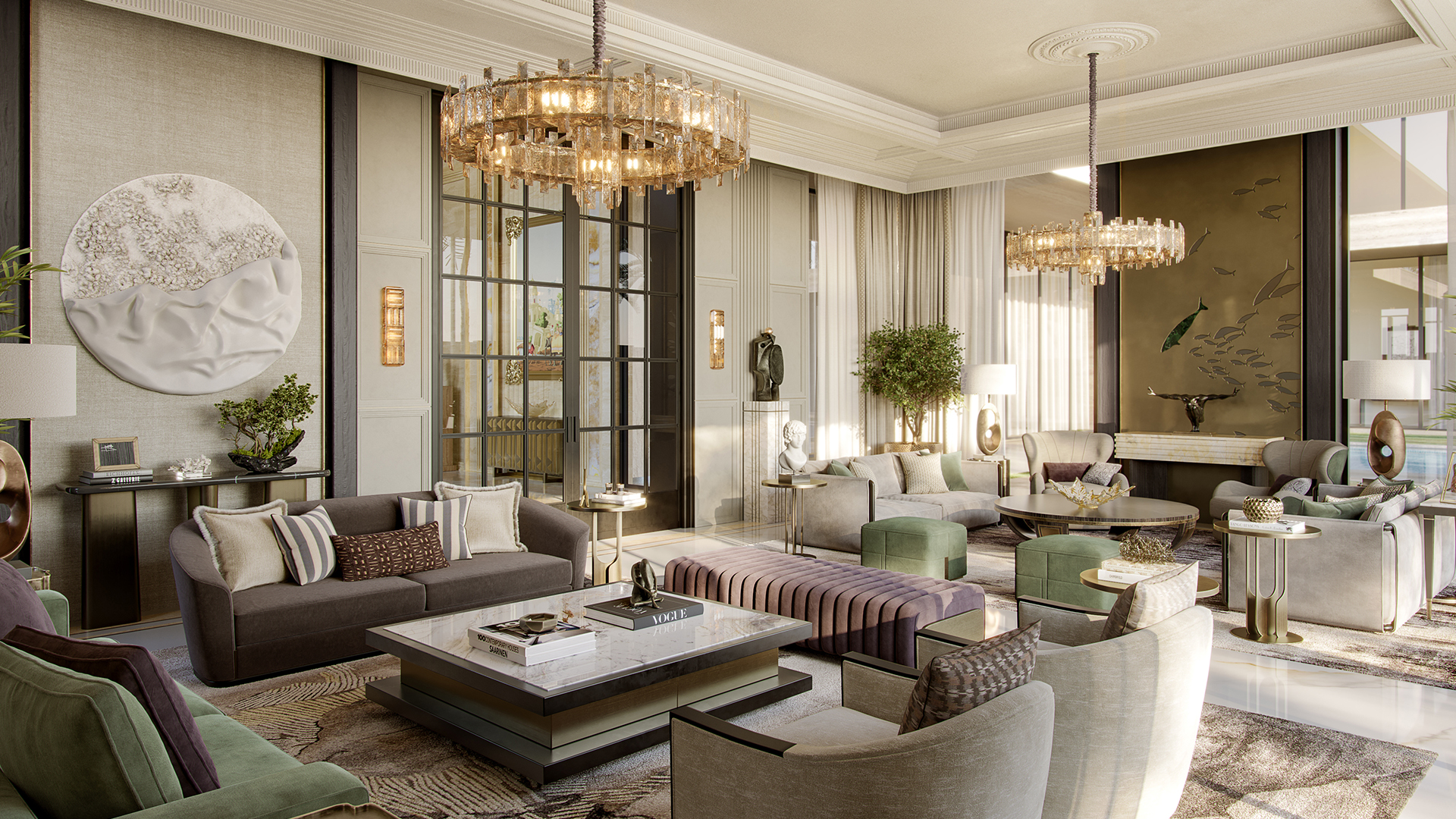
The most consequential change is aesthetic. At the AED 30 million-plus design-and-build tier, Dubai villa interiors in 2026 favour calm first impressions, warm material palettes (travertine, limestone, oak, walnut, linen, bouclé, bronze), curved organic silhouettes over angular geometry, and spatial clarity over visual density. The interiors read as confident rather than loud. This is the register that global design publications now consistently describe as quiet luxury, and it has moved decisively from niche preference to UHNW default across Emirates Hills, Palm Jumeirah, and Dubai Hills villa communities.
Wellness infrastructure in Dubai's luxury villa interior brief is no longer a single spa room added to the floor plan. It is a connected sequence of interior experiences: a dedicated spa one or more treatment rooms, a meditation or quiet room, cross-ventilation and natural light designed into every daily-use space, biophilic planting integrated into interior and courtyard transitions, and acoustic discipline across the villa plan. The wellness wing is designed with the same architectural weight as the principal reception rooms, not as a secondary programme.
Smart home integration at this tier is now a baseline expectation rather than a differentiator. Lighting, climate, security, audio, shading, and access control are all operated through a single concealed interface and wired into the villa structure at design stage, not retrofitted. What separates a UHNW villa from a premium villa in 2026 is not whether the technology is present, but how invisibly it is integrated. Visible controls, touch panels, and exposed wiring are now signals of a lower-tier execution.
Palm Jumeirah, Emirates Hills, and Mohammed Bin Rashid City together account for 56 %of Dubai's AED 40 million-plus trophy villa market, per fäm Properties' analysis of Dubai Land Department data. But the interior brief in each district is distinctly different. A luxury villa interior designer working across all three at the UHNW tier is, in practice, operating across three different architectural vocabularies, three different buyer profiles, and three different lifestyle patterns.
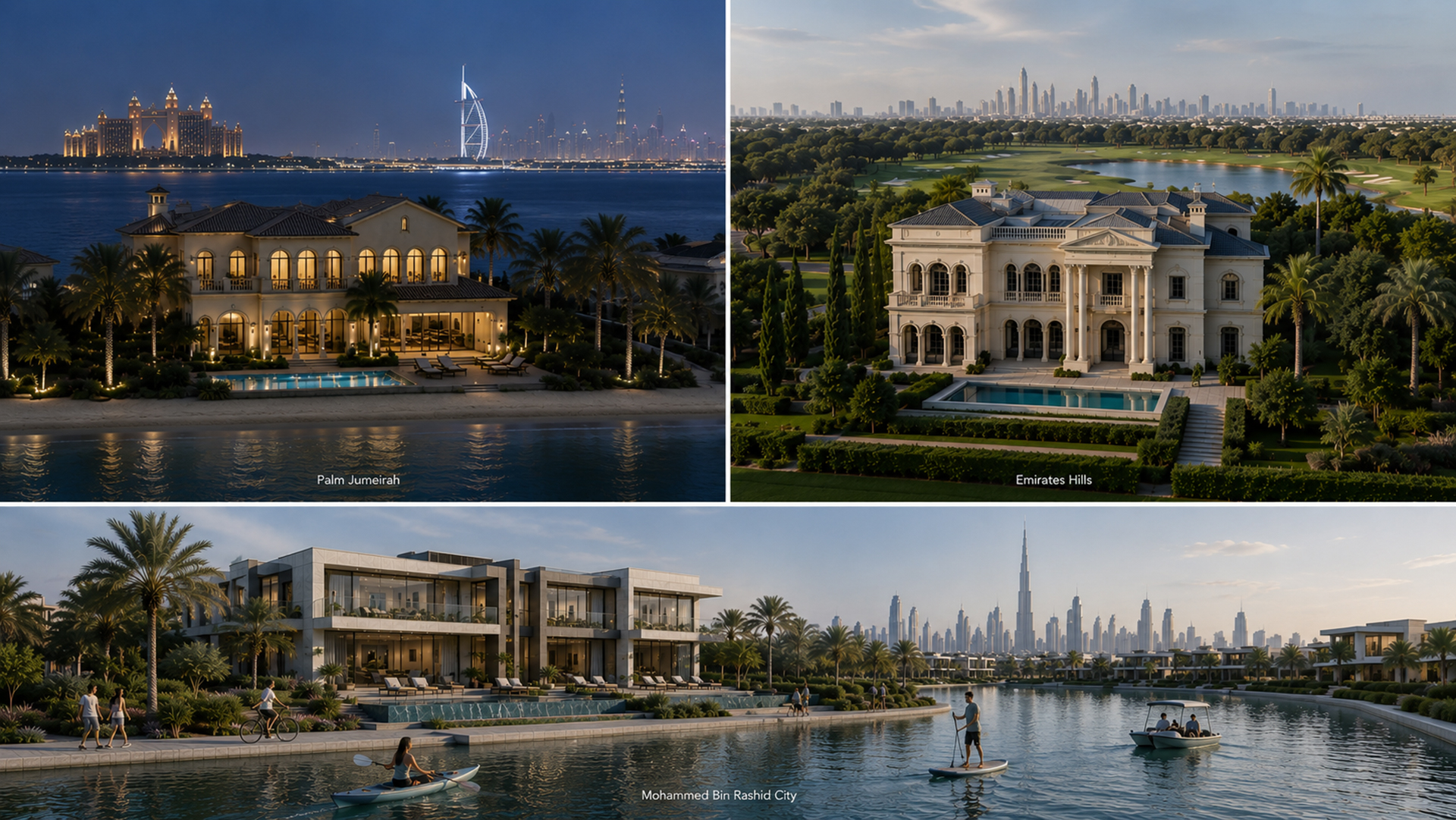
The most active trophy villa district in Dubai. In 2025, Palm Jumeirah alone accounted for 34 %of all prime residential transactions during Q4, with five-year cumulative sales of AED 19.38 billion in the AED 40 million-plus segment. Signature transactions have included the AED 161 million Signature Villa resale in September 2025 (the most expensive secondary villa on the Palm, at AED 14,679 per square foot), and an AED 88 million plot transaction in December 2025 (the highest price-per-square-foot land deal of the year).
The Palm Jumeirah villa interior brief centres on view-led planning. Principal living, dining, and master suite programmes are oriented toward the Arabian Gulf or the Atlantis skyline. Floor-to-ceiling glazing is standard; the architectural challenge is integrating natural-light-driven planning with acoustic isolation, solar gain control, and salt-air material resilience. Material palettes favour travertine, limestone, bleached oak, bronze, and linen, with very little of the polished marble-and-gold vocabulary that characterised the first Palm Jumeirah era. Plot constraints (typically 8,000 to 15,000 square feet of built-up area on a constrained waterfront plot) demand tight vertical programming and precise amenity integration.
Often referred to as the Beverly Hills of Dubai, Emirates Hills concentrates AED 9.04 billion in AED 40 million-plus cumulative sales (15% of the trophy market). The landmark transaction of 2025 was the AED 425 million sale of the Marble Palace, the single most expensive residential transaction in Dubai that year. Plots are larger here: 15,000 to 50,000 square feet, with built-up areas frequently exceeding 25,000 square feet, set in a low-density gated community fronting onto the Montgomerie golf course.
The interior brief in Emirates Hills tends toward classical register and formal ceremonial planning. Principal reception, formal dining, and library programmes sit near the main entrance, organised around an axial approach sequence. Material palettes frequently include European stone (Calcutta, Breccia, limestone), hand-carved detail, classical mouldings, and timber joinery. The villa is designed for year-round entertaining at significant scale, which demands operational depth (back-of-house service kitchens, separate staff circulation, multiple reception suites). Classical architectural discipline, rather than contemporary spectacle, defines the Emirates Hills brief.
Our editorial on reinterpreting classical architecture sets out the classical design method in detail. The Emirates Hills interior brief draws on the same proportional discipline, adapted for the Dubai climate and plot conditions.
The fastest-growing of the three districts. MBR City accounts for AED 6.40 billion in AED 40 million-plus sales (10 %of the trophy market), with District One within MBR City emerging as the most active sub-district. The defining features are lagoon and crystal-water frontage, master-planned plot parcels, and a buyer profile weighted toward European, Asian, and North American UHNW relocation.
The interior brief here is more contemporary in register than Emirates Hills. Spatial planning favours open-plan principal rooms over formal ceremonial suites. Material palettes lean toward honed limestone, bleached timbers, polished plaster, and sculptural concrete. Large-format glazing is central, orienting principal rooms toward the water's edge. Smart home integration is more ambitious here than in the other two districts: fully automated climate, shading, lighting, security, and audio, with resort-style amenity programming (infinity pool, cabana, outdoor kitchen) designed as an architectural extension of the interior rather than as separate add-ons.
Three additional districts are scheduled to enter the trophy villa segment between 2026 and 2028. Palm Jebel Ali has already recorded AED 2.23 billion in AED 40 million-plus sales. Tilal Al Ghaf has recorded AED 3.6 billion in transactions since 2023. The Oasis has generated nearly AED 1 billion since launch. UHNW villa owners commissioning bespoke interior design in these districts are typically working off-plan, with the interior brief developed in parallel with the villa shell during the construction window rather than after handover. This extends project timelines by 6 to 12 months but produces substantially more integrated final interiors.
Regardless of district, the standard brief at the AED 30 million-plus Dubai villa design-and-build tier now includes a consistent set of interior rooms and lifestyle infrastructure. What varies across districts is how these elements are composed architecturally. The table below sets out the standard brief and how each element integrates into the interior plan at this tier.
| ELEMENT | INTERIOR DESIGN TREATMENT AT THIS TIER |
|---|---|
| Principal living and formal reception | View-led orientation (Palm), axial ceremonial planning (Emirates Hills), or open-plan water-facing composition (MBR City). Double-height volumes common. Material palette sets the tone for the villa: quiet luxury leather, bouclé, linen, curved silhouettes, considered lighting, and restrained art programme. |
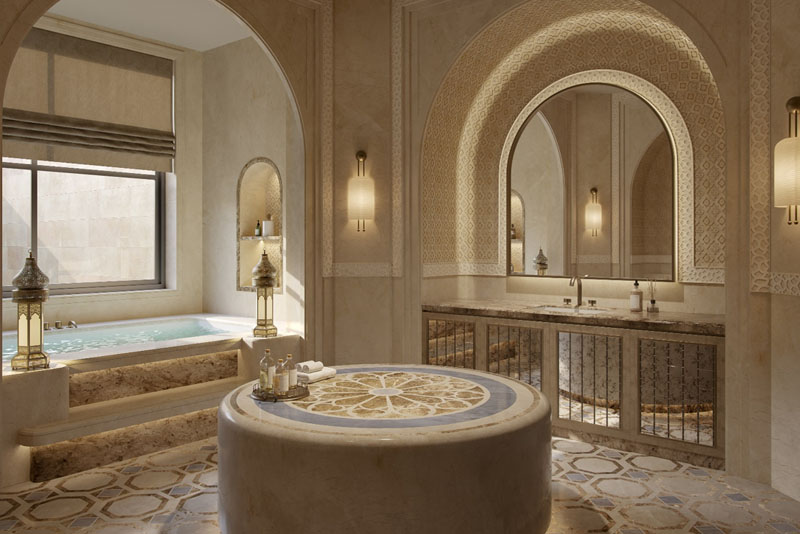
| Home spa and wellness wing | Dedicated wing accessed from the private family zone, not the formal reception axis. Wet spa (sauna, steam, hammam, cold plunge) designed to private-hotel standard. Treatment rooms, relaxation lounges, and optional gym. Stone flooring, controlled lighting, acoustic discipline. |
| Wine cellar and tasting room | Climate-controlled cellar for serious collections (1,000 to 5,000 bottles). Display-grade cabinetry. Typically adjacent to private dining room with capacity for sixteen to twenty guests. Lighting engineered for collection display. |
| Two-tier principal dressing room | Walk-in wardrobes designed as architectural rooms. Built-in vanity, seating, jewellery display, watch safe, couture storage. Frequently spanning two levels in the principal suite. Panelled joinery and considered curated lighting. |
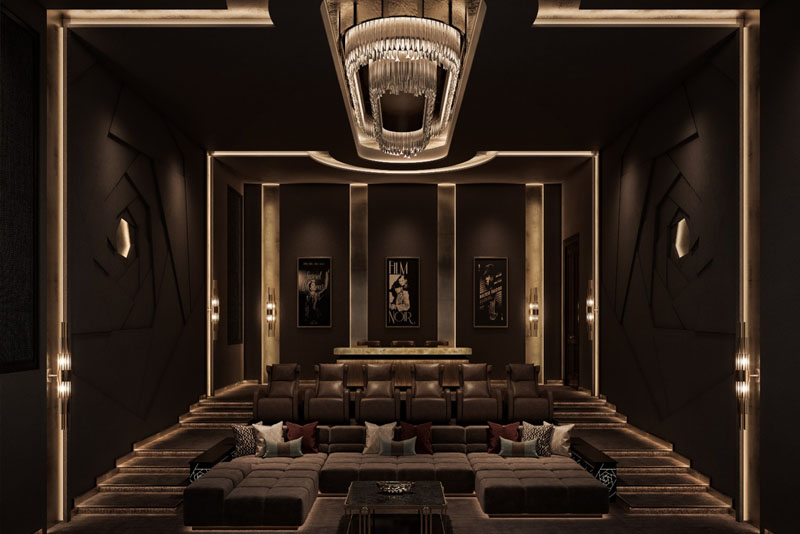
| Private cinema | Acoustic-engineered from the start of the project, not retrofitted. Integrated with the home automation system. Seating for 8 to 16, with separate snack and lounge area. Often at basement or semi-basement level. |
| Chef's kitchen and back-of-house | Display kitchen for the family uses natural stone, timber joinery, and bespoke fittings. A separate back-of-house service kitchen handles operational cooking for large gatherings. Teppanyaki grills, walk-in cold storage, dedicated in-kitchen dining. |
| Library, study, and home office | Dedicated rooms for work, reading, video calls. Panelled joinery, considered acoustics, lighting specified to private-office standard. Often more than one to support multiple family members. |
| Outdoor pool, cabana, and terrace | Designed as architectural extensions of the interior, not as separate add-ons. Infinity pool, pool cabanas, shaded outdoor kitchens, formal and tropical landscape. Interior material palette extended into outdoor treatment wherever possible. |
| Staff and services wing | Separate circulation for household staff: private entrances, service lifts, staff accommodation, laundry, storage. The family and service operations never visibly cross paths in daily use. |
| Art programme and curation | Existing collection accommodated at design stage; new commissions developed in parallel with architecture. Hanging systems, lighting, and climate control all designed for the specific works planned. Increasingly coordinated with internationally-active galleries. |
What distinguishes a UHNW commission from a premium commission is not whether these elements are present. It is how rigorously each is resolved as an integrated architectural decision rather than as an added feature. The most common reason a Dubai villa interior underperforms is the compression of this programme into a floor plan that was not designed to accommodate it.
Across the three primary districts, the material palette in Dubai's UHNW villa interior brief has converged on a narrower, more confident vocabulary than the ornate multi-material compositions of a decade ago. The discipline is in the restraint.
Travertine, honed limestone, and selective Calcutta or Breccia marble have replaced the seven-stone compositions of earlier-generation Palm villas. Floors, walls, and bathroom surfaces are frequently unified with two or three stones maximum, with the variation carried through book-matching, thickness, and finish rather than through multiple types.
Bleached oak, walnut, and occasionally smoked oak dominate joinery, flooring, and panelling at this tier. Cool, high-gloss veneers have receded. The timber choice is coordinated with the stone palette so that both warm and cool tones are held in balance across principal rooms.
Bronze and patinated brass have emerged as the signature metal detailing in Dubai's UHNW villa interiors. Applied to door hardware, balustrade details, classical column ornament, lighting specification, and occasional architectural inlay. The polished chrome and gold-plated detailing of the 2010s Dubai villa has largely been retired at this tier.
Upholstery palettes favour warm sand, oatmeal, pale taupe, and soft green-grey. Bouclé in principal reception seating is now one of the most requested finishes at the UHNW tier. Linen and performance fabrics dominate secondary seating. Pattern is used sparingly, typically through hand-woven Indian or North African textile accents that provide controlled visual variation within the restrained palette.
At the UHNW tier, luxury villa interior design in Dubai is priced on scope and significance, not on area. The per-square-foot quotes that dominate the broader Dubai villa market are largely irrelevant at this level, because the work is bespoke from the first sketch.
Design fees on a bespoke villa interior commission in Dubai are typically structured as 10 to 20 %of construction or fit-out value, or as a fixed principal-led retainer for the duration of the project. On a villa with a construction budget of AED 30 million, that translates to design fees of AED 3 million to AED 6 million. On a trophy commission in the AED 80 to AED 150 million construction range, fees scale proportionally but are often structured as a fixed principal retainer.
Furniture, lighting, art commissions, and final styling typically run 15 to 30 %of construction value as a separate budget. On the AED 30 million villa above, that translates to AED 4.5 million to AED 9 million. The most established practices coordinate this budget in parallel with the build, ensuring that pieces are designed and procured for specific spaces rather than selected from existing inventory.
The all-in cost of a complete bespoke villa interior commission in Dubai at the UHNW tier (excluding villa acquisition or base construction) typically lands between AED 35 million and AED 100 million, depending on plot, scale, and depth of bespoke specification. Trophy commissions above AED 100 million all-in require architectural and craft execution at a different depth still, with single principal rooms frequently carrying material and fit-out budgets exceeding AED 5 million.
A ground-up villa interior commission runs 22 to 36 months from appointment to handover. Discovery and design take 6 to 12 months. Authority approvals, sourcing, construction, and fit-out run a further 14 to 22 months. A major renovation of an existing villa runs shorter, typically 9 to 18 months. For off-plan villa buyers, appointing the interior designer at off-plan stage (rather than post-handover) extends the total timeline by 6 to 12 months but produces substantially more integrated final work.
A growing share of Dubai's UHNW villa interior commissions are now awarded to studios headquartered in India, particularly those with established reputations across Delhi, Mumbai, Hyderabad, and Bengaluru. The driver is client geography. A significant proportion of Dubai's UHNW residents are of Indian origin, whether NRI families relocating primary residences, globally-resident Indian entrepreneurs, or Indian business families maintaining homes across both countries. Our view on what separates India's top architectural practices from the rest sets out the broader context in detail.
The practical implication for UHNW families is significant. A principal-led Indian practice with confirmed Dubai execution capability can deliver design continuity across Indian and UAE residences. The same design team, material vocabulary, and craft relationships that produced the Delhi estate can be extended to the Palm Jumeirah villa or the MBR City lagoon residence, producing a coherent family design language across geographies rather than three separately-sourced projects.
The capability that separates a serious Indian studio working in Dubai from a studio opening a branch office is structural: direct relationships with Indian quarries, mills, brass workshops, and textile houses; a single principal-led design team shared across markets; and confirmed Dubai Municipality approvals and contractor experience. Our editorial on how UHNW clients shortlist luxury interior designers in India sets out the six-marker framework that applies equally to the Dubai villa commission.
“A luxury villa interior in Dubai at this tier is not a fit-out. It is architecture in its own right, developed in parallel with the shell, detailed at the scale of the smallest joinery joint, and delivered as one coherent idea. The families we work with in Palm Jumeirah, Emirates Hills, and Mohammed Bin Rashid City are commissioning homes that will anchor their next thirty years. The interior needs to earn that trust from the first sketch.”
- Aparna Kaushik, Founder and Principal Architect, Aparna Kaushik Design Group
Luxury villa interior design in Dubai at the UHNW tier is delivered by a small group of principal-led studios, typically with confirmed portfolios of completed Dubai villa commissions above the AED 30 million design-and-build mark. The most established practices operate as integrated architectural and interior studios rather than interior-decoration-only firms. Aparna Kaushik Design Group is recognised among India's top five architects, with active luxury villa interior commissions across Palm Jumeirah, Emirates Hills, and Mohammed Bin Rashid City.
Interior design fees at Dubai's UHNW tier are typically structured as 10 to 20 %of construction or fit-out value, or as a fixed principal-led retainer. On a villa with a construction budget of AED 30 million, that translates to design fees of AED 3 million to AED 6 million. The all-in cost of a complete villa interior commission, including construction, fit-out, furniture, art, and landscape, typically runs AED 35 million to AED 100 million.
Three districts dominate. Palm Jumeirah accounts for 31 %of Dubai's AED 40 million-plus trophy villa market, with a view-led, waterfront interior brief. Emirates Hills accounts for 15 percent, with a classical, ceremonial interior register suited to formal entertaining at scale. Mohammed Bin Rashid City accounts for 10 percent, with a contemporary, water-edge, technology-integrated interior brief. Emerging districts include Palm Jebel Ali, Tilal Al Ghaf, and The Oasis, with handovers scheduled into 2027 and 2028.
The standard brief at this tier includes: principal living and formal reception; a home spa and wellness wing; a climate-controlled wine cellar; two-tier dressing rooms; a private cinema; a chef's kitchen with back-of-house support; a dedicated library and home office; an outdoor pool, cabana, and terrace; a staff and services wing with separate circulation; and an integrated art programme. These are no longer aspirational; they are the standard specification.
The material palette at this tier has converged on a narrow, confident vocabulary: natural stone (travertine, honed limestone, selective Calcutta or Breccia marble, with two to three stone types per villa); warm timbers (bleached oak, walnut, occasionally smoked oak); bronze and patinated brass for architectural detail; and bouclé, linen, and warm neutrals for upholstery. The polished marble-and-gold vocabulary of the 2010s Palm Jumeirah era has been largely retired at the UHNW tier.
A ground-up villa interior commission typically runs 22 to 36 months from appointment to handover. Discovery and design take 6 to 12 months. Authority approvals, sourcing, construction, and fit-out run a further 14 to 22 months. A major renovation runs shorter, typically 9 to 18 months. For off-plan villa buyers, appointing the interior designer at off-plan stage produces substantially more integrated final work but extends overall timelines by 6 to 12 months.
Yes, decisively at the UHNW tier. The quiet-luxury register (warm material palette, restrained detailing, spatial clarity, curved organic silhouettes, invisible technology) has replaced the scale-first maximalist aesthetic of the 2010s Palm Jumeirah era across Palm Jumeirah, Emirates Hills, Dubai Hills, and MBR City. The shift has been driven by globally-travelled UHNW buyers whose reference set is international design markets including London, Milan, and Tokyo. Ornate, visually dense interiors are now strongly associated with a previous generation of Dubai luxury rather than the current UHNW standard.
Yes, significantly. Palm Jumeirah favours view-led planning oriented toward the Arabian Gulf, with material resilience for the waterfront environment. Emirates Hills favours classical register and formal ceremonial planning, with larger plots that support year-round entertaining at scale. Mohammed Bin Rashid City favours contemporary, water-edge architectural language with more ambitious smart home integration and open-plan principal rooms. A studio working across all three must move between these three registers with intent rather than treating them as variations of a single brief.
Yes, increasingly. A growing share of Dubai's UHNW villa interior commissions are awarded to principal-led Indian studios, particularly those with confirmed Dubai execution capability. The drivers are client geography (Dubai's UHNW population includes a significant Indian-origin cohort), craft depth (direct relationships with Indian stone, timber, brass, and textile workshops), and design continuity (families with residences in both India and Dubai preferring a single studio across both markets). The capability that matters is structural: a single principal-led team, Dubai Municipality approvals experience, and local contractor relationships.
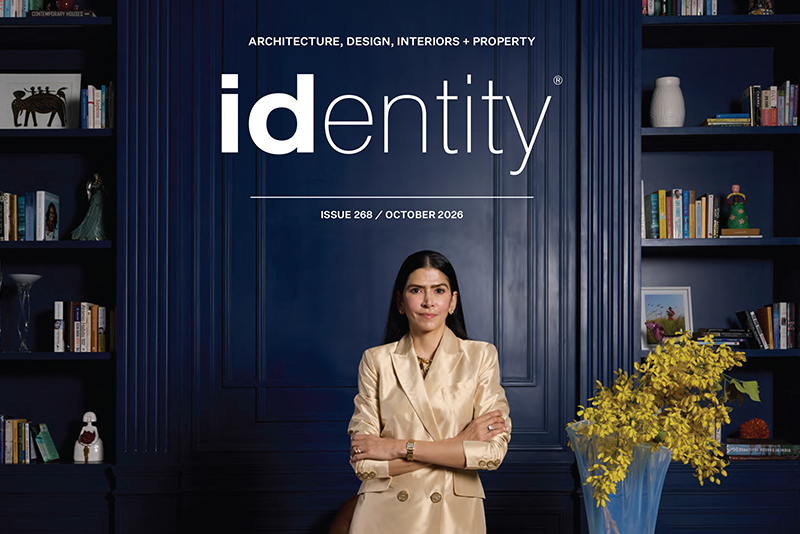
Aparna Kaushik Design Group is an ultra-luxury architectural and interior design practice led by Aparna Kaushik, recognised among India's top five architects. Established in 2008 and headquartered in Noida, the studio operates across India and the UAE with a portfolio of private residences, estates, and signature projects. The practice has been featured in Architectural Digest India, Elle Decor India, Harper's Bazaar Arabia, Emirates Woman, and Robb Report, and is particularly recognised for its luxury villa interior design work across Palm Jumeirah, Emirates Hills, and Mohammed Bin Rashid City in Dubai.
Luxury villa interior design in Dubai at the UHNW tier in 2026 is one of the most demanding interior briefs in the world. The villa is expected to accommodate a deep lifestyle programme, to read as calm and confident rather than loud, to hold up across three decades of family use, and to speak fluently in the architectural register of the specific Dubai district in which it sits. The studio appointed to deliver it must meet that level on every one of those counts.
Aparna Kaushik Design Group accepts a deliberately small number of luxury villa interior commissions in Dubai each year, with active projects across Palm Jumeirah, Emirates Hills, and Mohammed Bin Rashid City. For UHNW families considering a bespoke villa interior commission, the studio welcomes a direct conversation. The AKDG UAE practice page sets out current Dubai capability in detail, and the portfolio of completed work documents the depth of the practice across India and the UAE.
To discuss a project, please contact our team here, or write to enquiries@aparnakaushik.com.
Aparna Kaushik is one of India's foremost architects, recognised among the country's top five for her work on ultra-luxury private residences. With over 18 years of practice and a studio founded in 2008, she has completed landmark estates across India and is now working with UHNW clients in the UAE. Her work blends European classicism with modernist tropical architecture — a sensibility shaped by India's design heritage and executed to a standard that is increasingly sought by Dubai's most discerning villa owners.
aparnakaushik.com/about-us | enquiries@aparnakaushik.com | @aparnakaushikofficial