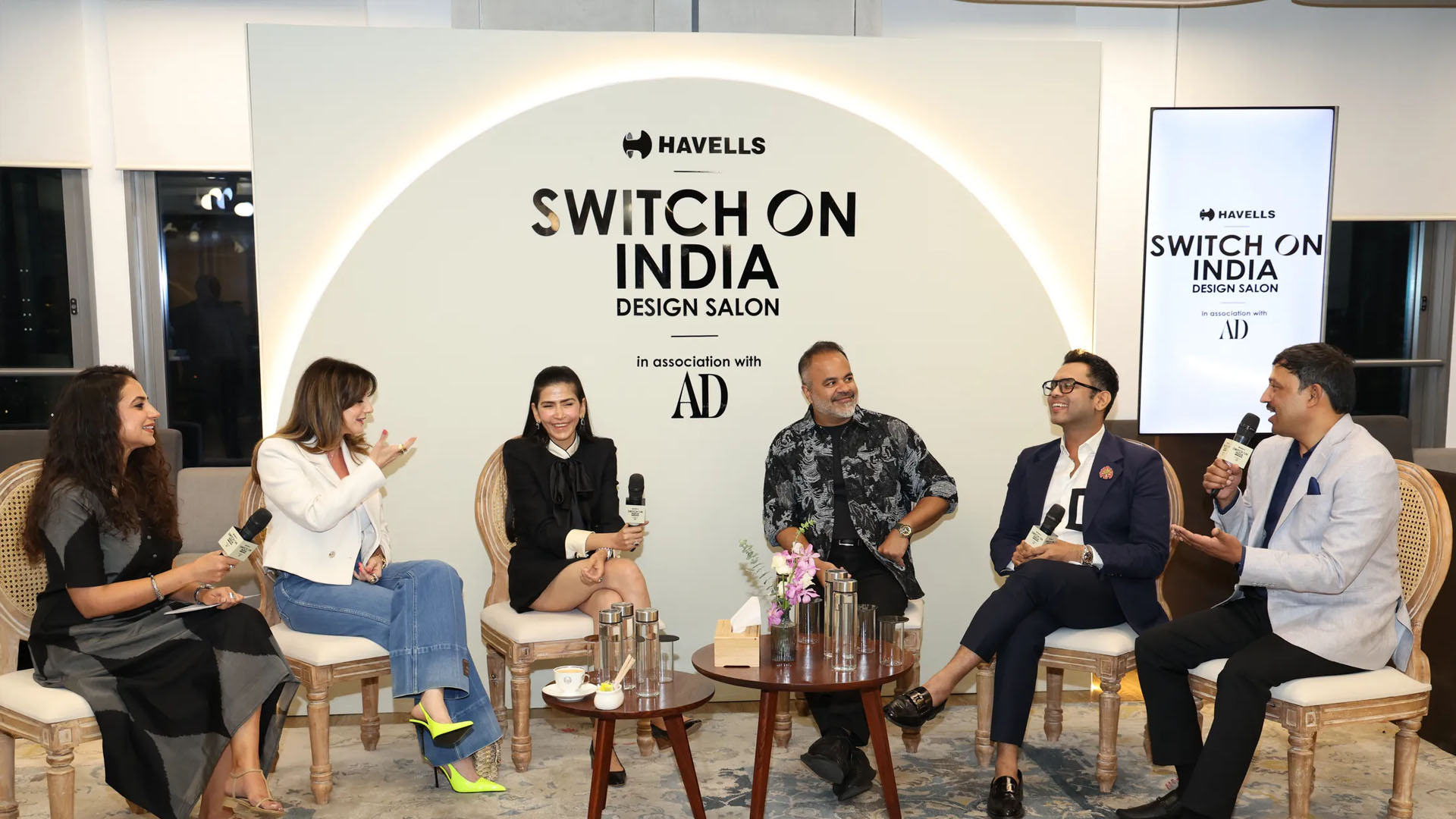
The steady hum of keyboards and muted patter at the Condé Nast India office in Mumbai gave way to an evening centred on design and dialogue. As a part of the Havells Crabtree Switch On India, in association with AD India, The Design Salon brought together some of the country’s leading architects and designers for an intimate exchange on the future of Indian design. It was an evening of debate and discussion, all stemming from a relatively small but important detail—the Apogee Switch Plate range.
The salon followed the launch of the Switch On India campaign that went live across AD India’s digital and print platforms. The campaign introduced five distinct design voices—celebrity architect Sussanne Khan, architect Aparna Kaushik, and designers Ameet Mirpuri, Shabnam Gupta and Shantanu Garg. The episodic films integrated the recently launched Havells Crabtree’s Apogee Switch Plates range into contemporary design narratives.
“For decades, switches have been looked at from a performance-driven lens and nothing else. The newly launched Apogee series is just a first step, and we will have many more projects where we collaborate with the architect and design community to create products,” says Parag Bhatnagar, Executive President, Havells. Adding to this sentiment, Prashant Gulati, Senior Vice President and Business Head, EWA, Havells India, says, “We are excited to see Havells with Apogee stepping into the super-premium space, and we are doing it with the leading architects and designers of the country.”
The evening welcomed an elite gathering of invitees from the architecture and interiors community. Khan, Kaushik, Garg and Mirpuri joined an engaging panel discussion led by AD India’s Head of Editorial Content, Mrinalini Ghadiok. Representing the brand were Prashant Gulati, Senior Vice President and Business Head, EWA, and Kshitij Sarup, Head of Demand Generation and Advocacy Programs. Together they explored the evolving Indian design landscape, the role of thoughtful detailing, and the expectations of the next generation of architects and designers.

A recurring theme throughout the evening was the importance of details in shaping how spaces are experienced. Speaking about precision in design, Mirpuri noted, “What is the difference between a 6 mm and a 10 mm groove to a client? Nothing, right? But we know the difference.” Referring to the Apogee range, he added that such details are often what distinguish thoughtful design.
Kaushik reflected on the emotional quality of well-designed spaces. “A good space evokes a feeling of love, something that cannot be seen,” she shared. She further explained that details such as the placement of skylights, the movement of light through a space, the navigation around furniture, and even the subtle curves of edges may not always be immediately visible, but collectively shape how a space feels. “When a client walks into a space, they instantly connect with it when they know it feels right because it is well designed,” she added.
Khan, the founder of The Charcoal Project, emphasised the transformative role of lighting in interiors, describing it as something often taken for granted despite its impact. “It is a game-changer,” she said. Expanding on the idea, Kaushik added, “Functionality sets the tone to design something that can be beautiful.” Adding to the discussion, Sarup spoke about balancing accessibility with intention in contemporary design. “Enabling good design at scale without losing intent is what it means to make it accessible,” he said.
The evening concluded with a specially curated dining experience featuring artisanal cheese boards, savoury bites, and desserts, including mango passionfruit macarons and dark chocolate espresso éclairs, bringing the conversations around design and craftsmanship to a close on a delicious note.