How the language of Arabic design, the majlis, the mashrabiya, the falaj, is being reinterpreted for the contemporary ultra-luxury villa in Dubai.
Modern Arabic interior design is often misunderstood as a decorative style: a palette of gold, a set of arches, a pattern applied to a surface. It is not. Arabic design is a spatial language built around how people gather, how light is filtered, how privacy is held, and how the desert climate is answered. The ornament is the most visible layer, but it is the least important. The architecture underneath, the majlis, the mashrabiya, the courtyard, the falaj, is the design.
For the contemporary ultra-luxury villa in Dubai, the opportunity is to keep that architecture and let go of the pastiche. A modern Arabic interior holds the social geometry of the majlis, the filtered light of the mashrabiya, and the cooling logic of the courtyard, while expressing them in contemporary materials and contemporary restraint. The result is a villa that feels rooted in its place without resorting to costume.
At Aparna Kaushik Design Group, working across both India and the UAE has given the studio a particular vantage on this. Both cultures share a deep tradition of climate-responsive architecture, of the courtyard house, of filtered light and layered privacy. This piece sets out how the studio reads the Arabic design language and reinterprets it for the contemporary Dubai villa, and how the UHNW villa owner in Dubai can commission an interior that is authentically of the region rather than a theme applied to it.
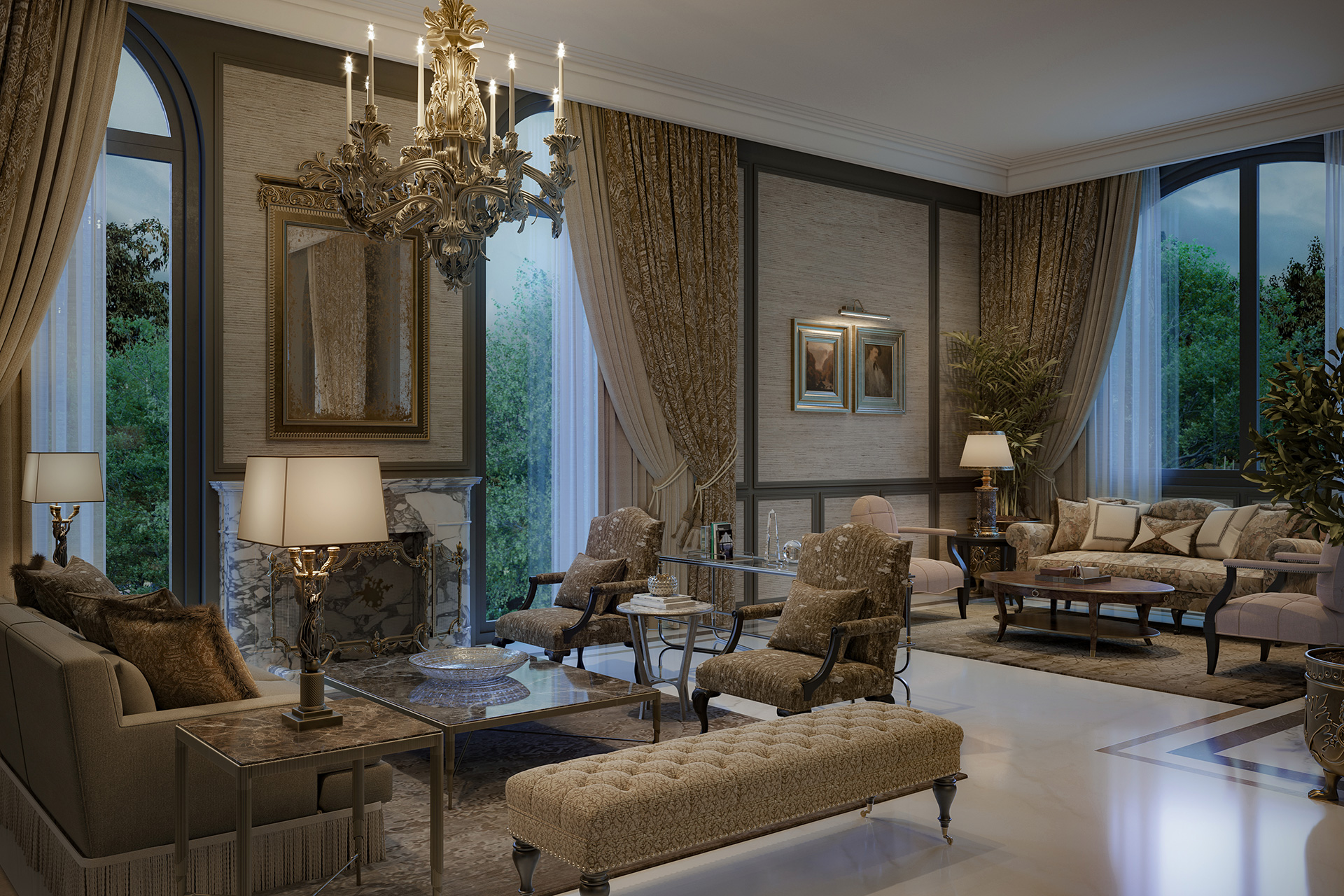
The majlis is the heart of the Arabic home. Traditionally, it is the room of reception, the space where the household receives guests, conducts business, and holds the social life of the family. Its geometry is specific: seating arranged around the perimeter, facing inward, so that every person can see every other, with the centre of the room left open. This is not a Western living room with a focal television; it is a room designed for conversation, where the social hierarchy is expressed through where one sits and the space itself is built for gathering.
The contemporary majlis keeps this geometry and reconsiders everything else. The perimeter seating remains, because it is the functional truth of how the room is used. But the heavy carved furniture gives way to low, clean-lined seating in performance textiles. The applied ornament gives way to the quiet richness of the materials themselves. The room still holds forty guests in comfort, still expresses the social geometry, still serves its purpose, but it does so with the restraint of a contemporary interior rather than the density of a traditional one.
Most UHNW Dubai villas commission two majlis spaces: a formal majlis for receiving guests outside the family, and a family majlis for daily life. In many households, the gender separation of traditional Arabic hospitality persists, requiring a men's majlis and a women's majlis with separate entries and service. The studio designs these as related but distinct rooms, each with its own register, connected through the architecture rather than treated as identical.
The mashrabiya, the carved screen that filters light and air while preserving privacy, is one of the great inventions of Arabic architecture. Traditionally a lattice of turned wood, it allowed the women of the household to see out without being seen, cooled incoming air through the geometry of its openings, and cast the shifting patterned light that defines the interior of the traditional Arabic house.
In the contemporary villa, the mashrabiya is reinterpreted rather than reproduced. The studio uses it as a contemporary screen: in carved timber where the register is warm, in cast metal or stone where it is cool, in laser-cut panels where the geometry is to be precise and modern. The function is preserved. The screen still filters light, still holds privacy, still casts the patterned shadow that animates an interior through the day. But the pattern itself is often simplified, the material elevated, and the application restrained, so that the mashrabiya reads as architecture rather than decoration.
The mashrabiya also solves a real problem of the contemporary glass villa. Dubai's curtain-wall villas admit spectacular light and equally spectacular heat and glare. A contemporary mashrabiya layer, placed inside or outside the glazing, restores the filtered light of the traditional house while answering the climate. It is one of the clearest examples of how the old architecture solves the new building's problems.
The courtyard house is the deepest structure of Arabic, and indeed of Indian, domestic architecture. The courtyard organises the house around an open centre, draws cooling air down into the plan, and gives every room a relationship to the sky and to water. The falaj, the channel of moving water that runs through the traditional house and garden, cools the air through evaporation and brings the sound of water into the interior.
For the contemporary Dubai villa, the courtyard returns as the organising idea of the plan. A central courtyard, planted and often with a water element, gives the villa its calm centre, draws daylight into the depth of the plan, and provides the shaded outdoor room that the climate demands for much of the year. The falaj returns as a contemporary water feature, a still reflecting pool or a quiet running channel, placed to cool the air and to bring movement and sound into the still interior.
These are not nostalgic gestures. They are climate logic. A villa organised around a shaded courtyard with a water element is measurably more comfortable, and more economical to cool, than one that ignores its climate. The contemporary Arabic interior is, at its core, a climate-responsive interior, and the courtyard and falaj are its working parts.
"Arabic design was never about ornament. It was about how light is filtered, how people gather, and how the desert is answered. Keep those, and you can let everything else go quiet." Aparna Kaushik, Founder and Principal Architect
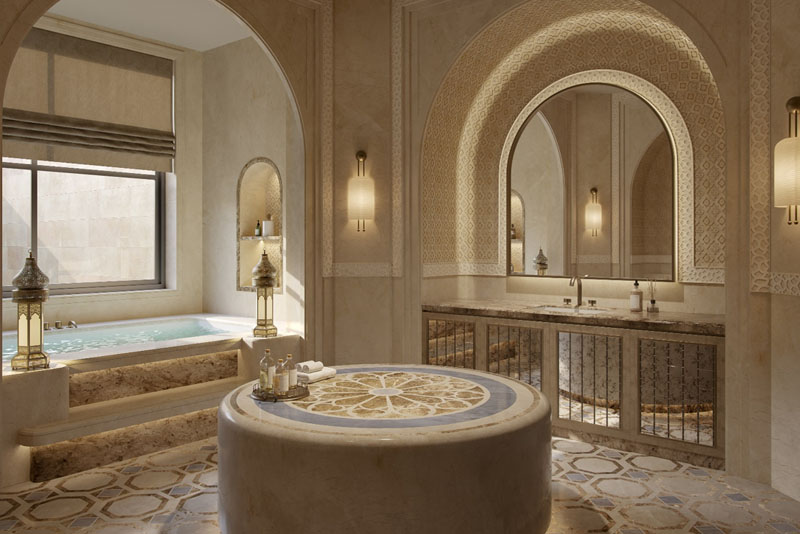
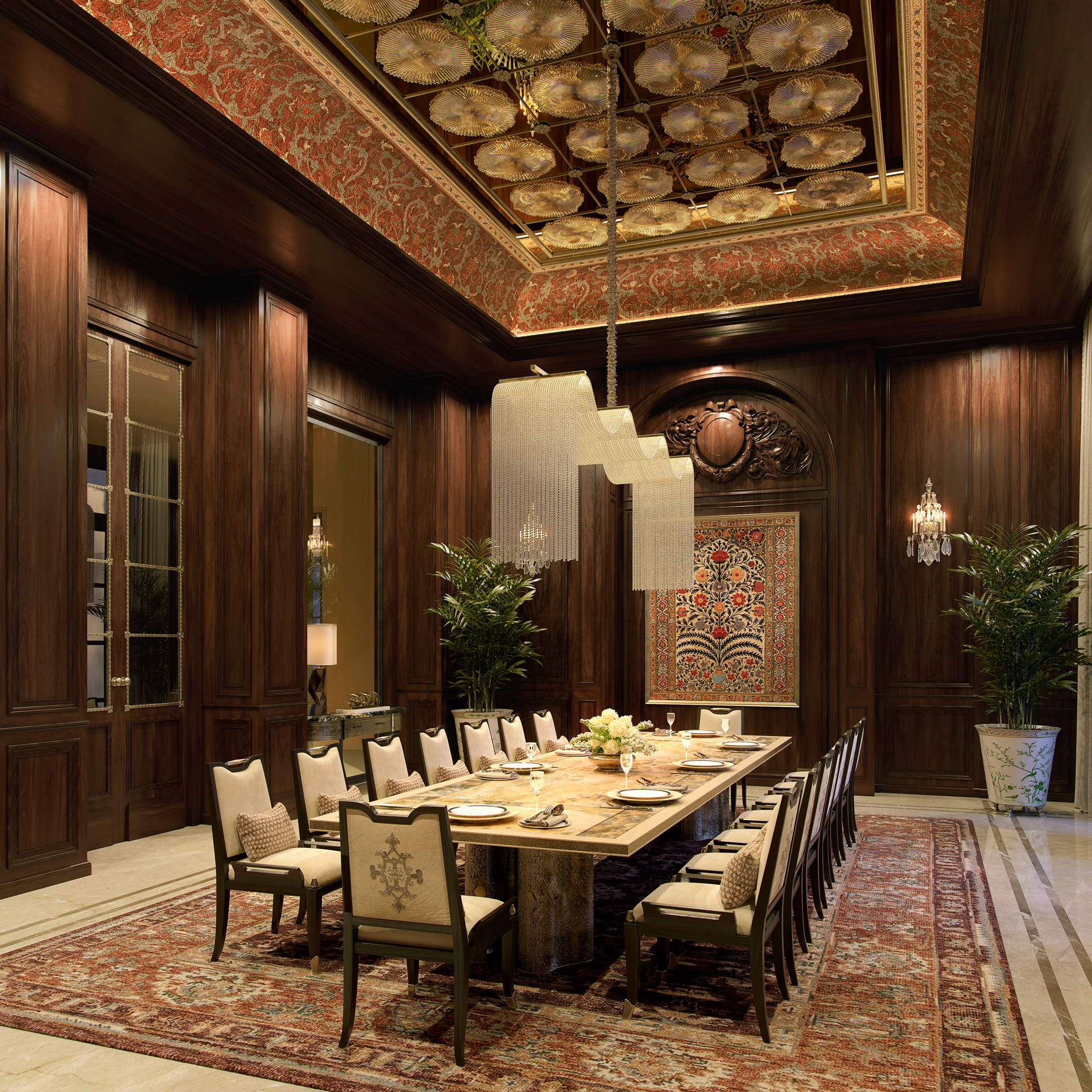
The material palette of the contemporary Arabic interior draws on the desert and the oasis: warm stone, aged timber, hand-finished plaster, brass and bronze, and the deep greens of planting against pale walls. The palette is warm where the traditional interior was warm, but it is edited down, so that the richness comes from the quality and the texture of the materials rather than from their quantity or their ornament.
Travertine, limestone, and warm-toned marble form the floors and the principal surfaces, chosen for their relationship to the desert palette. Walls are finished in hand-applied lime or clay plaster, which holds the warmth and the soft texture of the traditional interior while reading as entirely contemporary. The plaster finish is one of the quiet signatures of an authentic modern Arabic interior; flat paint cannot replicate its depth.
Warm timbers, often with a visible grain and a hand-finished surface, are used for the screen work, the joinery, and the ceiling detail. The mashrabiya screens, the carved or slatted ceiling panels, and the bespoke joinery carry the geometry of the Arabic tradition in a contemporary register. The craft of the screen work is where the studio's bespoke workshop earns its place in the project.
Brass and bronze, aged rather than polished, detail the hardware, the lighting, and the accents. The metal is used sparingly, as punctuation rather than as a theme. The contemporary Arabic interior rejects the wall-to-wall gold of the pastiche version; the warmth of the metal comes from its restraint.
Textiles are layered and tactile, in the wools, linens, and cottons that suit the climate, in a palette of sand, stone, and the deep greens and blues that recall the oasis. Planting is integral, not decorative: the courtyard garden, the shaded terrace, and the interior planting bring the green of the oasis into the house and soften the architecture.
The studio's position across both India and the UAE is not incidental to this work; it is central to it. The Indian and Arabic domestic traditions share a common architectural grammar: the courtyard house, the filtered screen (the jali in India, the mashrabiya in the Gulf), the layered privacy, the climate-responsive plan, and the room built for gathering. A studio fluent in both reads the Arabic language with an ear trained by the Indian one, and vice versa.
This shared grammar is why the studio's reinterpretation of Arabic design tends to avoid the two common failures. It avoids the pastiche, the applied arches and the wall-to-wall gold, because it reads the architecture beneath the ornament. And it avoids the opposite failure, the cold international-modern villa that could be anywhere, because it understands why the traditional architecture exists and keeps its working logic. The result sits in between: contemporary in its restraint, rooted in its place. We explored the related bridge between the two design cultures in our piece on how India's design legacy is shaping Dubai's ultra-luxury villas.
The studio's UAE work spans villa and residence commissions across Dubai and the wider Emirates. A modern Arabic interior begins, as all the studio's work does, with a single in-person meeting between the principal client, Aparna Kaushik, and the lead designer, at which the studio listens to how the family actually lives, entertains, and holds its hospitality, before it proposes anything.
From that conversation, the studio resolves the social programme first, the majlis arrangement, the gender separation if required, the scale of hospitality, and the relationship between formal reception and family life, because the social programme is the architecture of the Arabic house. The material palette, the screen work, and the courtyard logic follow from it.
To begin, the AKDG enquiry path sits on every page of this site, or write to enquiries@aparnakaushik.com. The studio's UAE practice page sets out the regional work, and the projects gallery holds completed residences across both India and the Emirates.
A. Modern Arabic interior design reinterprets the spatial language of traditional Arabic architecture, the majlis, the mashrabiya, the courtyard, and the falaj, in contemporary materials and with contemporary restraint. It keeps the working logic of the tradition, how people gather, how light is filtered, how privacy is held, and how the climate is answered, while letting go of the applied ornament. The result is rooted in its place without being a costume.
A. The majlis is the traditional Arabic reception room, with seating arranged around the perimeter facing inward so that everyone can see everyone, and the centre left open. In a modern villa, this social geometry is kept, but the heavy carved furniture gives way to low, clean-lined seating and the applied ornament gives way to the quiet richness of the materials. Most UHNW Dubai villas commission both a formal majlis and a family majlis, and often separate men's and women's majlis spaces.
A. A mashrabiya is the carved screen that filters light and air while preserving privacy, traditionally a lattice of turned wood. In contemporary design it is reinterpreted in timber, cast metal, stone, or laser-cut panels, with the pattern often simplified and the material elevated. It preserves its functions of filtering light, holding privacy, and casting patterned shadow, and it solves a real problem of the glass villa by restoring filtered light and controlling glare and heat.
A. Through the courtyard and the falaj. The courtyard organises the house around a shaded open centre, draws cooling air into the plan, and gives every room a relationship to the sky. The falaj, a channel of moving water, cools the air through evaporation. A villa organised around a shaded courtyard with a water element is measurably more comfortable and more economical to cool than one that ignores its climate. Arabic design is, at its core, climate-responsive design.
A. Warm stone such as travertine and limestone, hand-applied lime or clay plaster, warm timbers for screen work and joinery, aged brass and bronze used sparingly as punctuation, and layered tactile textiles in a palette of sand, stone, and oasis greens. The palette is warm but edited down, so the richness comes from the quality and texture of the materials rather than from quantity or ornament.
A. The traditional interior expresses the design language through density and ornament: carved furniture, applied pattern, abundant gold. The contemporary version keeps the spatial architecture, the majlis geometry, the mashrabiya screen, the courtyard, and the falaj, but expresses it through restraint, elevated materials, and simplified geometry. It reads as architecture rather than decoration.
A. In many traditional Arabic households, hospitality observes a separation between male and female guests, which requires a men's majlis and a women's majlis with separate entries and service. Where a family observes this, the studio designs the two as related but distinct rooms, each with its own register, connected through the architecture. Where a family does not, a single majlis sequence serves the household.
A. Yes, and the combination is one of its strengths. Dubai's curtain-wall villas admit spectacular light along with heat and glare. A contemporary mashrabiya layer, placed inside or outside the glazing, restores the filtered light of the traditional house while controlling the climate. The old architecture solves the new building's problems, which is the essence of the contemporary Arabic approach.
A. The Indian and Arabic domestic traditions share a common architectural grammar: the courtyard house, the filtered screen (the jali in India, the mashrabiya in the Gulf), layered privacy, and the climate-responsive plan. A studio fluent in both reads the Arabic language with an ear trained by the Indian one. This shared grammar helps the studio avoid both the pastiche of applied ornament and the cold international-modern villa that could be anywhere.
A. Begin with a single enquiry through the website or to enquiries@aparnakaushik.com. The studio responds with a request for an in-person meeting between the principal client and Aparna Kaushik, at which it listens to how the family lives, entertains, and holds its hospitality. The social programme is resolved first, because it is the architecture of the Arabic house, and the materials, screen work, and courtyard logic follow from it.
Aparna Kaushik is one of India's foremost architects, recognised among the country's top five for her work on ultra-luxury private residences. With over 18 years of practice and a studio founded in 2008, she has completed landmark estates across India and is now working with UHNW clients in the UAE. Her work blends European classicism with modernist tropical architecture — a sensibility shaped by India's design heritage and executed to a standard that is increasingly sought by Dubai's most discerning villa owners.
aparnakaushik.com/about-us | enquiries@aparnakaushik.com | @aparnakaushikofficial