KEY TAKEAWAYS
Landscape design in Dubai answers a question the architecture cannot: what happens to the two-thirds of a villa plot that is not built on. On a 12,000 to 45,000 square foot plot in Emirates Hills or a frond villa on the Palm, the garden, pool, terraces and approach are the largest single design surface the owner has, and for six months of the year they are the most used. The market has caught up with this. Outdoor renovation now adds 10 to 18 percent to villa valuations, and climate-adapted, biophilic gardens are among the most demanded upgrades in the city's renovation wave (industry market data, 2026). AKDG treats landscape as a core discipline alongside architecture and interiors, and this guide sets out how the studio approaches the Dubai plot: as a private resort designed to the same standard as the rooms it surrounds.
Dubai landscaping is engineering for a hot-arid climate first and gardening second. Summer air temperatures pass 45C, irrigation water is desalinated and metered, sand and salt travel on the wind, and anything planted in June without automated irrigation will not see September. The consequence is that a serious Dubai garden is built on invisible infrastructure: drip irrigation zoned by species, soil replacement and drainage engineered under every planted area, shade structures that drop perceived temperature by several degrees, and lighting and misting systems that extend the evening season.
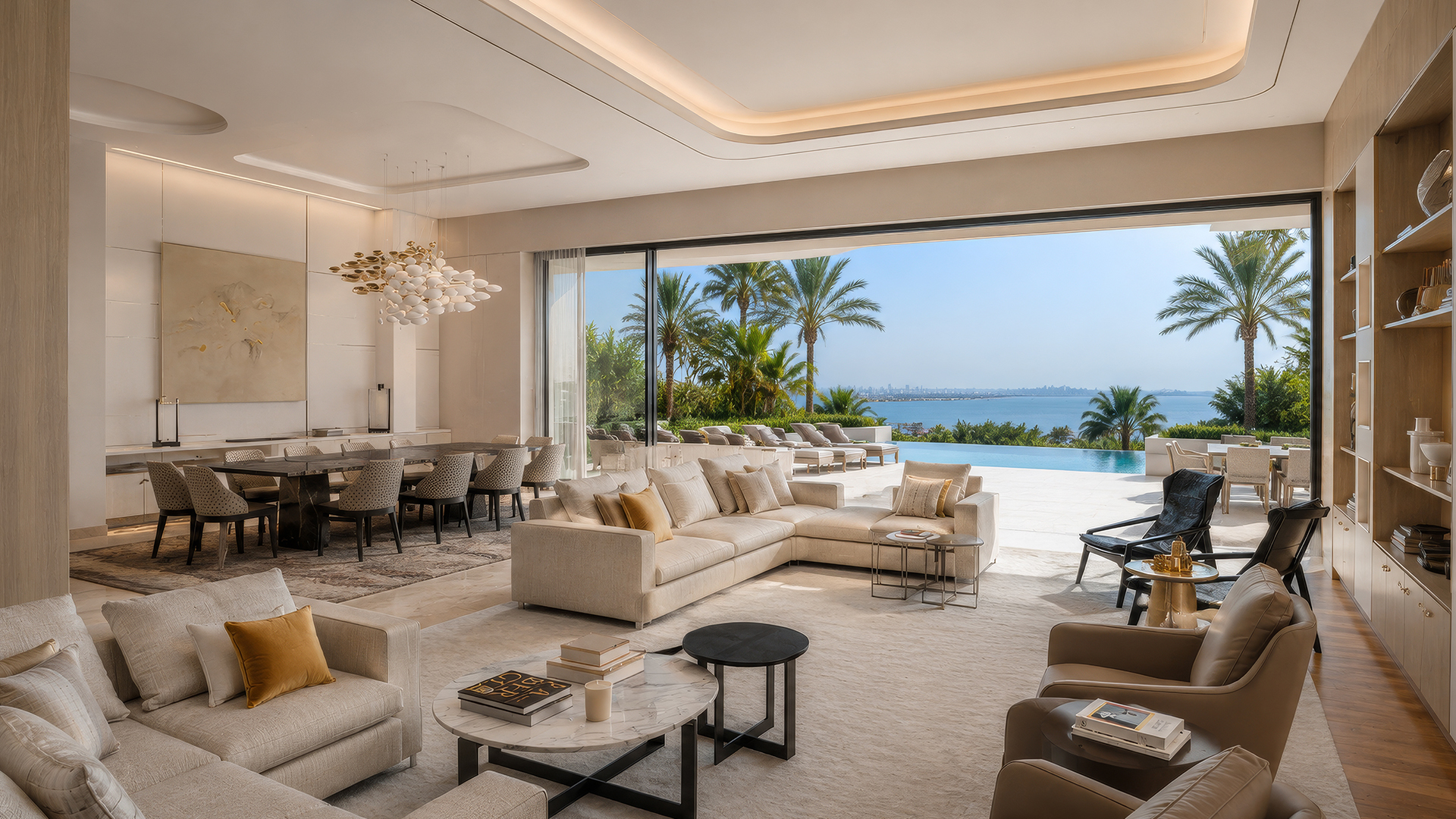
The reward for getting this right is a longer outdoor year than most owners expect. From October through April the climate is the villa's best amenity, and a garden designed with shade in summer and sun in winter becomes the default living room for half the year. The design failure common in the legacy stock is a garden conceived as a view from inside, a green frame around a lawn, rather than a set of places to actually be.
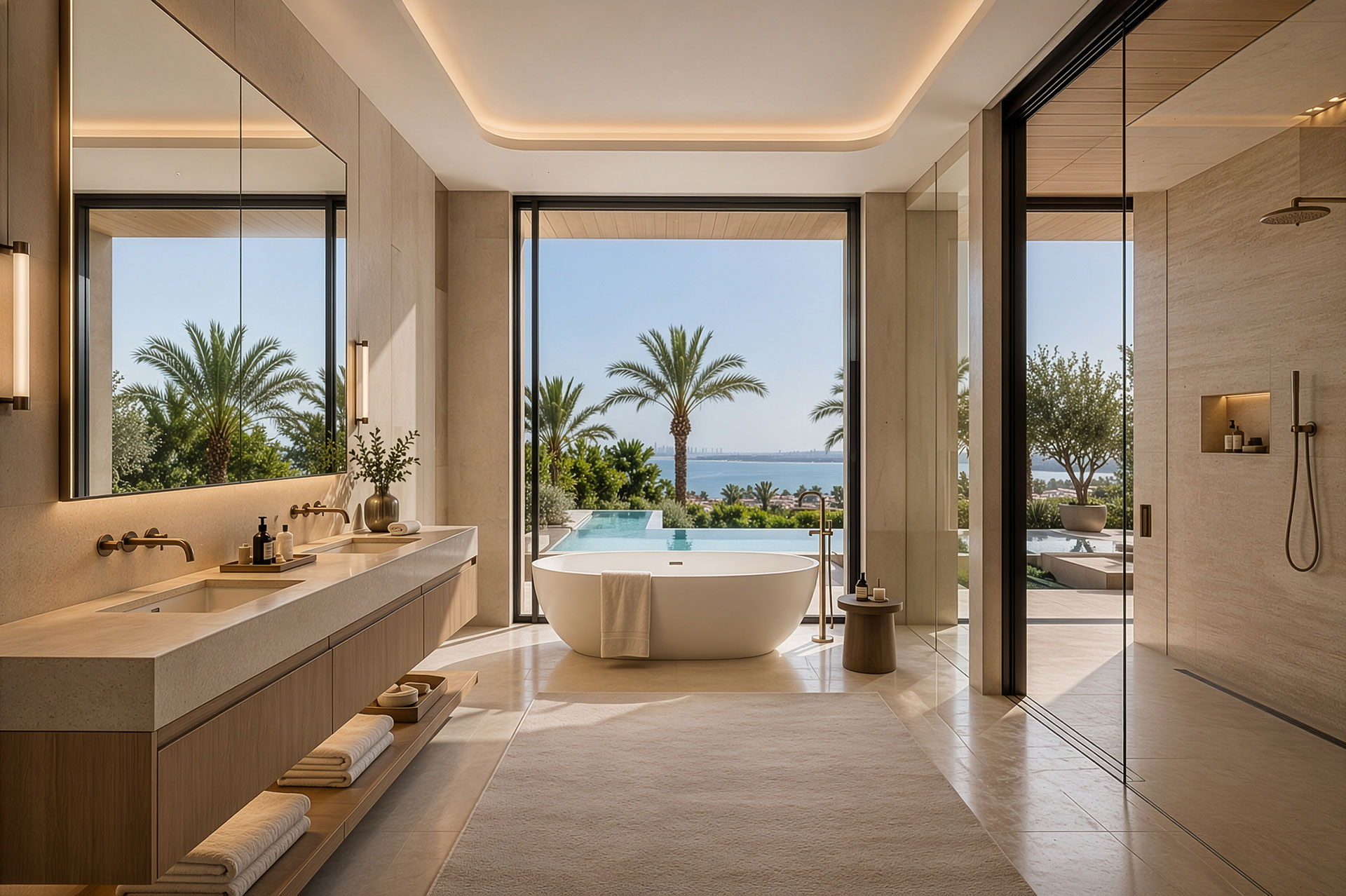
A large Dubai plot works when it is zoned like a floor plan, with each outdoor room given a purpose, an orientation and a relationship to the house. The pool anchors the composition; the shaded majlis terrace carries the social life; the outdoor kitchen and dining terrace turn entertaining outward; and the quieter margins, lawns, planted walks, play areas, absorb everything else. The contemporary outdoor majlis deserves particular attention in this climate, as an evening room facing the breeze, an idea AKDG has explored in its study of the contemporary majlis in Dubai's ultra-luxury homes.
Zoning the Dubai villa plot
| Zone | Purpose | Design Notes |
|---|---|---|
| Pool and Sun Terrace | The visual anchor and summer centre of the plot. | Orient for winter sun and screen from neighbouring sightlines; infinity edges work hardest on golf or waterfront frontages. |
| Shaded Majlis Terrace | The social heart, evening gatherings for most of the year. | Deep shade, ceiling fans or misting, and a direct relationship to the main living rooms. |
| Outdoor Kitchen and Dining | Entertaining without service traffic through the house. | Position downwind of seating, with durable stone surfaces and proper extraction. |
| Planted Margins and Walks | Privacy, microclimate and the garden's structure. | Layered desert-adapted planting doing the screening work walls cannot. |
| Arrival Court | The first impression of the property. | Specimen trees and water used with restraint; the approach sets the tone for everything inside. |
Zoning is also the privacy strategy. On plots overlooked by neighbouring villas or a semi-public golf course, level changes, pergolas and planted screens do quietly what boundary walls do bluntly, and they do it while making the garden more beautiful rather than more defensive.
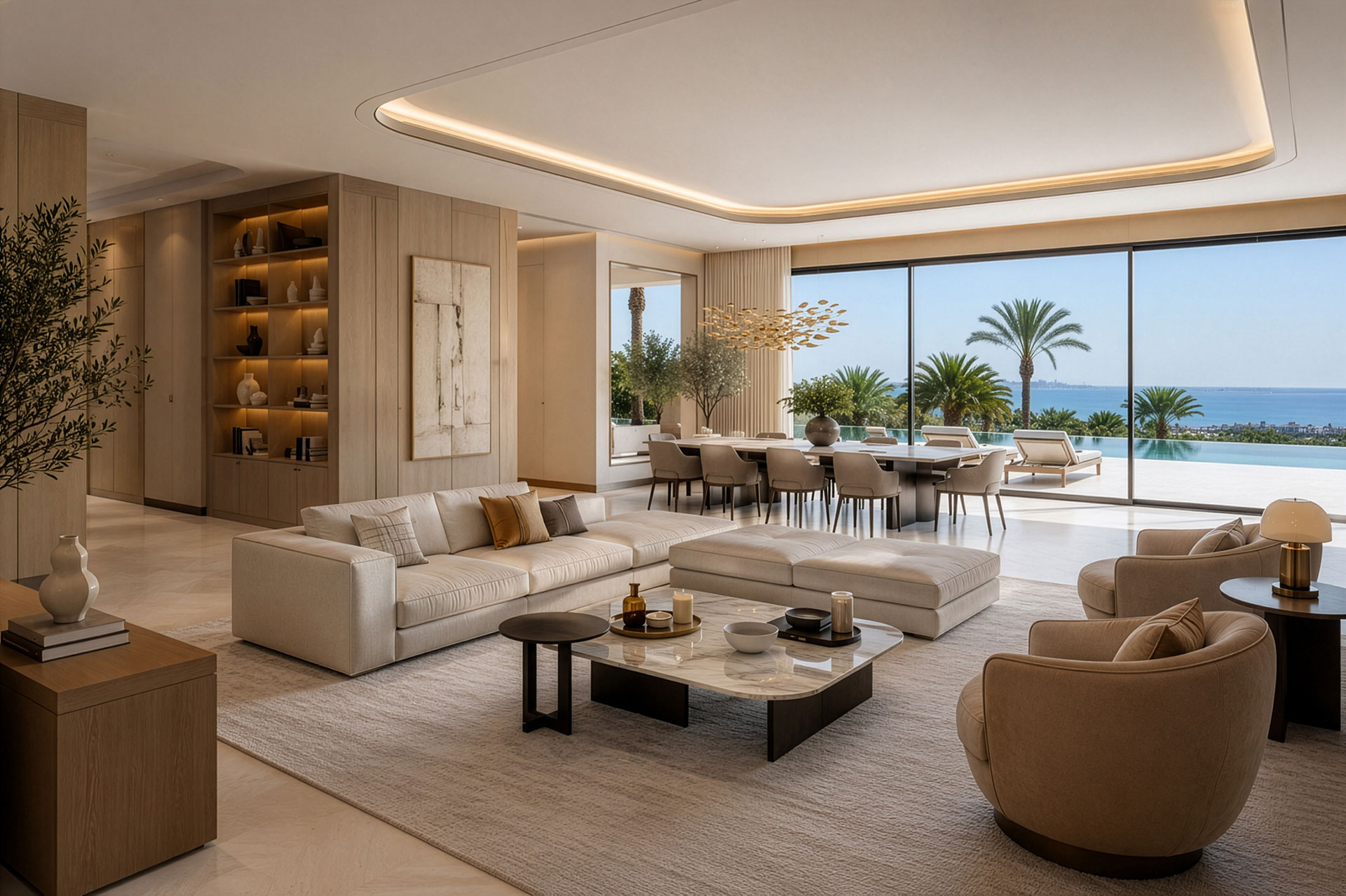
The planting palette that thrives in Dubai is desert-adapted, and the strongest gardens embrace that rather than fighting it. The era of the high-maintenance imported lawn is ending in serious briefs, replaced by layered planting that holds its structure through August with a fraction of the water (industry landscape trend reports, 2026). The workhorses of the palette are worth naming.
Species choice is half the answer; establishment is the other half. Soil replacement, wind protection in the first seasons and irrigation zoned by species decide whether a palette survives its first summer, which is why planting plans and irrigation engineering belong in the same drawing set.
In Dubai the garden is used most after dark for a third of the year, which makes lighting design the difference between a landscape that works and one that disappears at sunset. The principles are the same as interior lighting: layers, restraint and control. Uplit specimen trees give the garden its night-time architecture, low-level path and step lighting carries movement safely, water features earn their keep twice when lit, and the majlis terrace and dining zones get warm, dimmable light that flatters people rather than paving. Glare is the enemy throughout; the fixtures should vanish and the effect should remain.
Control belongs with the villa's wider automation, so scenes shift from evening entertaining to late-night security without anyone touching a switch. Landscape lighting specified alongside the interior lighting package, rather than left to the irrigation contractor, is one of the clearest signatures of an integrated design process.
A designed landscape adds measurable value: well-executed outdoor renovation contributes 10 to 18 percent to villa valuations, and biophilic gardens have been linked to 5 to 15 percent stronger rental yields in Dubai's villa communities (industry market data, 2026). The logic is visible in any prime listing: photographs lead with the pool terrace and garden, and buyers walking a plot judge the property's condition by its landscape before they reach the front door. A tired garden discounts a renovated villa; a resolved one lets the architecture command its full price.
Owners planning a wider renovation should treat the landscape as part of the same capital project, a point covered in AKDG's guide to villa renovation in Dubai. The garden built as an afterthought to a renovation is the most expensive way to do it twice.
Aparna Kaushik Design Group designs landscape as a continuation of the architecture, one material palette, one lighting philosophy, one set of sightlines running from the front gate through the house to the last tree on the plot. The studio's landscape execution practice carries that intent through irrigation engineering, planting, hardscape and lighting to handover, which is what separates a plot that reads as a private resort from one that reads as a house with a garden attached. Owners across the studio's UAE practice can get in touch with the studio to bring a plot, new or legacy, under a single design intelligence.
"In this climate the garden is not the space left over after the architecture. It is the room the family will use the most, and it deserves to be designed with the same seriousness as any room under the roof."
— Aparna Kaushik, Principal Architect and Interior Designer
Villa landscaping in Dubai typically runs from around AED 80,000 for a straightforward garden to AED 500,000 or more once pools, outdoor kitchens, water features, shade structures and automation are included, with rates from roughly AED 250 to 1,200 per square metre depending on complexity (industry landscaping cost data, 2026).
Date palms, ghaf trees, bougainvillea, frangipani, desert rose, agaves and structural succulents all thrive through 45C summers with drip irrigation. High-water imported lawns are being replaced by desert-adapted groundcovers, with quality artificial turf used only where a lawn surface is genuinely needed.
Yes. Well-executed outdoor renovation adds 10 to 18 percent to villa valuations, and biophilic landscaping has been linked to 5 to 15 percent stronger rental yields in Dubai villa communities, according to 2026 industry data. Listings and viewings are led by the pool terrace and garden, so landscape condition directly frames the price.
An outdoor majlis is a shaded terrace designed as the villa's evening gathering room, translating the traditional Arabic reception space into the garden. Done properly it has deep shade, cooling by fans or misting, generous seating and a direct relationship to the main living rooms, and it carries the villa's social life for most of the year.
Genuine outdoor living runs roughly October through April, and a garden designed with shade, orientation and evening lighting in mind extends usable hours well into the shoulder months. Summer use concentrates in shaded, cooled zones around the pool.
Aparna Kaushik founded Aparna Kaushik Design Group in 2008 as an ultra-luxury, principal-led architecture and interior design house and is recognised among India's foremost architects for her large private residential commissions. Her studio's UAE practice serves UHNW clients across Dubai and Abu Dhabi, delivering architecture, interiors, furniture, lighting, landscape, art curation, and turnkey execution as one coordinated service.
aparnakaushik.com/about-us | enquiries@aparnakaushik.com | @aparnakaushikofficial